Hi everyone,
I've started a new site where I'll be regularly writing short pieces about Hebrew words and phrases. I'll be dealing with both modern and classic Hebrew, slang, new terms, and the influences of other languages. I'll be particularly focusing on the origins of the words and phrases and how they passed from one language to another.
You can visit the site here:
http://balashon.blogspot.com/
(If you're interested, the RSS feed is at http://balashon.blogspot.com/atom.xml )
I'm really interested in your feedback, criticism and comments, and also questions or ideas for new entries.
Looking forward to hearing from you and seeing you on the site.
Sunday, February 19, 2006
new site: Balashon - Hebrew Language Detective


Friday, January 06, 2006
praying for Sharon
I’ve been running into more and more people lately, who’ve been saying things like “I can’t pray for Sharon” or “I don’t hope he dies, but he’s getting what he deserves.”
I’ve been trying to think of my response to such folk. I think I’ve got it: You have no idea what Judaism is.
First of all, it’s just silly to say that it’s divine punishment that Sharon has fallen ill now. Besides the ridiculous level of chutzpa to assume to know God’s plans, I wouldn’t say that it’s very rare that 78-year olds have strokes! Are all the other ones divine punishments as well? Are you prepared to tell the child of another 80 year old that their father’s stroke is due to divine punishment?
But more importantly: Sharon has both merits and faults. We all do. For those who opposed his policies, particularly the disengagement plan – his faults are many, perhaps greater than any other Israeli leader. But he has so many merits! He’s saved us in wars, led the settlement enterprise, put down the intifada. While his faults might be greater than ours, his merits – his actions on behalf of Am Yisrael and Eretz Yisrael – are greater than any of ours! Even his greatest critics! How many of you can claim to done anything for this country on the same level? So a little modesty. That’s Jewish.
But maybe you say that his faults outweigh his merits, and therefore he deserves what he’s getting. I have one question for you. When exactly did you get your hands on God’s record book? I’d really like to see it. How do you do in there? You have simply no idea. The Tanach and Chazal are full of examples where people get credit for certain deeds that outweigh seemingly more evil ones. We need to thank the Egyptians despite our slavery. There are evil kings who get Olam Haba because of building one city. How many of you live in towns that Sharon helped build? Bottom line – we don’t know what counts for what. We can’t.
So what’s left? Maybe I haven’t convinced you. Maybe you feel that the evil of the disengagement certainly outweighs any good he’s done for the country. Destroying settlements cancels out building them. The pain of the displaced is far greater than the comfort of those who have found homes. And therefore you can not pray for his health! What you are asking God to do is implement Midat HaDin. Come down in judgment! Punish the evildoer! Well, guess what. Midat HaDin is not a precise weapon that you can choose to affect one person. It affects us all. Can you handle it?
אם עוונות תשמור י-ה ה' מי יעמוד
How dare you call for Midat HaDin! Can our country handle it? We need to ask for Midat HaRachamim, to look at our merits and not our sins. Haven’t you ever prayed on Rosh HaShana and Yom Kippur? What do you think the whole tefila is about? Do I actually need to quote the tefilot?
But maybe you say that perhaps I’m right, but emotionally you can’t bring yourself to pray for Sharon. Well guess what – we have a system that helps us frame our emotions with proper actions. It’s called halacha. Say the tefilot. Pray for his health. And maybe, listen to the rabbis. Did you hear Rav Grossman talk about Sharon’s dedication to Jewish education and families? How about Rav Batzri’s call for prayer? Do you think Rav Ovadia Yosef doesn’t care about the destroyed batei knesset and schools? What about Rav Elnekave? The Rav of Gush Katif who’s been sitting in a hotel since the summer? When he called on all Jews to pray for Sharon, not just because another Jew is ill but because of his merits – was he wrong?
And if for some reason all this hasn’t convinced you, and you still can’t bring yourself to pray for his health – at least have the decency to do so in a way that nobody else can hear it. Some of us are actually busy worrying about the health of the Prime Minister of the State of Israel, retired General, Ariel (ben Vera) Sharon.
I’ve been trying to think of my response to such folk. I think I’ve got it: You have no idea what Judaism is.
First of all, it’s just silly to say that it’s divine punishment that Sharon has fallen ill now. Besides the ridiculous level of chutzpa to assume to know God’s plans, I wouldn’t say that it’s very rare that 78-year olds have strokes! Are all the other ones divine punishments as well? Are you prepared to tell the child of another 80 year old that their father’s stroke is due to divine punishment?
But more importantly: Sharon has both merits and faults. We all do. For those who opposed his policies, particularly the disengagement plan – his faults are many, perhaps greater than any other Israeli leader. But he has so many merits! He’s saved us in wars, led the settlement enterprise, put down the intifada. While his faults might be greater than ours, his merits – his actions on behalf of Am Yisrael and Eretz Yisrael – are greater than any of ours! Even his greatest critics! How many of you can claim to done anything for this country on the same level? So a little modesty. That’s Jewish.
But maybe you say that his faults outweigh his merits, and therefore he deserves what he’s getting. I have one question for you. When exactly did you get your hands on God’s record book? I’d really like to see it. How do you do in there? You have simply no idea. The Tanach and Chazal are full of examples where people get credit for certain deeds that outweigh seemingly more evil ones. We need to thank the Egyptians despite our slavery. There are evil kings who get Olam Haba because of building one city. How many of you live in towns that Sharon helped build? Bottom line – we don’t know what counts for what. We can’t.
So what’s left? Maybe I haven’t convinced you. Maybe you feel that the evil of the disengagement certainly outweighs any good he’s done for the country. Destroying settlements cancels out building them. The pain of the displaced is far greater than the comfort of those who have found homes. And therefore you can not pray for his health! What you are asking God to do is implement Midat HaDin. Come down in judgment! Punish the evildoer! Well, guess what. Midat HaDin is not a precise weapon that you can choose to affect one person. It affects us all. Can you handle it?
אם עוונות תשמור י-ה ה' מי יעמוד
How dare you call for Midat HaDin! Can our country handle it? We need to ask for Midat HaRachamim, to look at our merits and not our sins. Haven’t you ever prayed on Rosh HaShana and Yom Kippur? What do you think the whole tefila is about? Do I actually need to quote the tefilot?
But maybe you say that perhaps I’m right, but emotionally you can’t bring yourself to pray for Sharon. Well guess what – we have a system that helps us frame our emotions with proper actions. It’s called halacha. Say the tefilot. Pray for his health. And maybe, listen to the rabbis. Did you hear Rav Grossman talk about Sharon’s dedication to Jewish education and families? How about Rav Batzri’s call for prayer? Do you think Rav Ovadia Yosef doesn’t care about the destroyed batei knesset and schools? What about Rav Elnekave? The Rav of Gush Katif who’s been sitting in a hotel since the summer? When he called on all Jews to pray for Sharon, not just because another Jew is ill but because of his merits – was he wrong?
And if for some reason all this hasn’t convinced you, and you still can’t bring yourself to pray for his health – at least have the decency to do so in a way that nobody else can hear it. Some of us are actually busy worrying about the health of the Prime Minister of the State of Israel, retired General, Ariel (ben Vera) Sharon.
Monday, December 26, 2005
Chanukah and the three layers of darkness
Channukah, the Festival of Lights, is actually enveloped in three layers of darkness.
First of all, it takes place at night, and is the only holiday whose only action is taken at night. Even Pesach, where the Seder takes a major role, there are sacrifices brought during the day.
Secondly, it takes place in the winter, the only holiday to really do so. Purim is in the end of winter, but is connected with Pesach in the spring. All the biblical holidays take place around the harvest season, from Pesach in the beginning, to Sukkot in the end. This is logical, since without a holiday framework, it would be very easy to forget God in the midst of the agricultural preparations, and forget to thank Him after the harvest. But the winter is sort of a “dead” time for farmers and there is no real need for a holiday. And not only does Channukah fall in the winter, but according to the Maharal it is actually associated with the winter solstice, the shortest day (and longest night) of the year. He comes to this conclusion based on the idea that the man was created on 1 Tishrei; therefore the world was created on 25 Elul. If the year is divided into 4 seasons, with the first day of the season being either the equinox or the solstice, then 4 months after the 25th of Elul is the 25th of Kislev – Channukah. An additional interesting source is the midrash in Avoda Zara, which talks about how Adam was afraid as the days got shorter, but when the days began to get longer (after the winter solstice), he had a celebration lasting 8 days. While Channukah is not mentioned in the midrash, the connection seems to be there nonetheless. (Also interesting is the following midrash that discusses Adam’s similar fear in the first night, until the day began to break.)
Lastly, I would say that Channukah takes place in Judaism’s “Dark Ages.” It falls during the Second Temple period, between the closing of the Tanach, and the earliest rabbinic literature. The biblical period of Ezra and Nechemia end with a whimper, not a bang, dissolving into the fog of history. There are many questions about this period brought up both in rabbinic and historical circles --- neither seem to know exactly what took place when. Historians admit they have huge gaps of knowledge here. And from the Jewish perspective, the large number of questions related to the time points to either a general fog over the era or the after-effect of not having authoritative literature. One issue is the “missing 170 years” that have fascinated rabbis and scholars. Another is the status of the Apocrypha – the Sefarim Chitzonim, external books to the biblical canon. Their “in-between” status seems to characterize the entire period. Also, many of the questions surrounding Channukah itself stem from the lack of official texts. Why is there no Masechet Channukah? Where do the Macabees fit into the chain of tradition described in the beginning of Pirkei Avot? What were Babylonian and the rest of Diaspora Jewry’s reactions to these events? Why does the story of the vial of oil only appear in such late rabbinic sources? I won’t venture an answer to these questions, but had the bible continued until the events of Channukah, or had the rabbinic literature flourished at the same level it did a few hundred years later, it is likely we would not be as confused as we are now.
To truly understand the significance of the darkness surrounding Channukah, it is important to understand the alternatives. Why does it seem so strange to us that a holiday would take place in the dead of winter, seemingly in the middle of the night?
To answer this, lets look at the Jewish calendar. The Jewish day begins generally at nightfall, although in certain circumstances (in the Temple for example) it begins at daybreak. Either of these options are very natural times to start a day – either when you wake up or when you go to sleep. Similarly, the Jewish year starts either in the fall (Rosh Chodesh Tishrei) or in the spring (Rosh Chodesh Nisan). Both of these are natural choices as well, to start the year either at the beginning of the harvest, and the blossoming of the plant life, or at the end of the same cycle. The two parallel options are also expressed in the disagreement as to whether the world was created in Nisan or Tishrei (and to some extent continued in the Rashbam’s proposition that
perhaps the first day began at daybreak as well).
But if we look at the non-Jewish, Western concept of when to start the day and the year, it appears rather strange. Their day begins at midnight, and their year begins on the first of January. Why initiate a central unit of time in the middle of the dark? The day is dislocated from the natural human rhythms of rising and resting, and the year would seem to have no agricultural significance at all.
The answer to this may be found in a different perspective on nature, on the world we live in. While a day or a year beginning in the most inactive part of the cycle might seem strange to someone living within that cycle, to someone observing that cycle it is the most opportune time. There are far fewer changes occurring, and this allows the research to be more precise. This scientific approach, looking at the world from the outside, contrasts with the natural approach that involves only living in the natural order of the world. Who most represented the scientific approach to life? The Greeks.
The Greeks represented logic, science, and philosophy. I think it is not a coincidence that when the Jews were in their “dark ages”, the light of Greek civilization was at its highest. This was the time of Socrates, Plato and Aristotle. In a way, Greek civilization provided the first real competitor for Judaism’s monotheism. The philosophers rejected idolatry, but for different reasons than Judaism. They felt that logic was the source of ethics and morals, and that view led to their eventual conflict with Judaism (who they initially had great respect for).
Until that time Judaism represented the natural approach, not the scientific one. So why should the holiday representing victory over the Greeks seem to have such heavy themes of the scientific approach? Why at night? Why in the winter? In a sense, Channukah seems to even ignore Rosh Chodesh, where as all the other holidays are either connected to the new moon or the full moon. (Rav Yoel Bin-Nun discussed in a lecture how up until the time of Channukah, Rosh Chodesh had a very prominent role in Jewish life – with stores closed, the people assembled, etc. Antiochus made three decrees against the Jewish people – prohibiting the observance of Shabbat, circumcision and Rosh Chodesh. For Shabbat and circumcision the Jews were willing to sacrifice their lives, but for Rosh Chodesh they weren’t. And according to tradition, only what the Jews were willing to sacrifice for was able to endure – and the previous significance of Rosh Chodesh did not endure.)
Rabbi Tzadok HaKohen of Lublin said that the Oral Law developed to its full potential after the victory of the Hasmoneans over the Greek culture, a culture characterized by deep analysis and hair-splitting argument. These virtues were converted to a holy nature with the victory of Israel over Greece. This was the fulfillment of the verse “God will give beauty to Yefet and this beauty will dwell in the tents of Shem” (as per the gemara in Megillah 9b).
After the victory, through which we proved that “the beginning of wisdom is the fear of God”, we could begin the successful integration of science, logic and philosophy into our natural world, into the world of the Written Law. Only then could the Oral Law truly begin to flourish. We didn’t need to concede to the Greeks, nor did we need to ignore them. Only from our position of military and intellectual strength could we succeed where others failed – the integration of our tradition with new logic and science.
Perhaps this is another way of understanding the famous statement by the Maharal that the eight days of Channukah represent the supernatural as opposed to the natural seven-day order of the week. In a sense, science is also supernatural, by allowing us to step out of the natural order of the world and observe it from the outside.
Only with our synthesis of the two worlds – the natural and the scientific, the traditional, agricultural Written Torah with the logical, philosophical concepts of machloket can the greatness of the Talmud be reached. Or in the language of the rabbis, both the tearing down mountains of “oker harim” (logic) and the mountain of “Sinai” (tradition) are needed to truly achieve the mantle of the Oral Law.
This is the message of Channukah. It comes to say that even though it is the middle of the winter, even though it is night, we come to light a candle to say that we are not bound by the natural order of the world. Even as Jews bound by the yoke of tradition and Torah, we can, through science and logic, break through to the supernatural. Through a synthesis of Torah and logic, we can achieve true intellectual freedom.
Neo Makes Aliyah
This is something my wife noticed years ago - a strong parallel between the movie the Matrix, and the choice between living in America and making aliya.
Check out this flash movie, they did a great job: FREE YOUR MIND, NEO - inspired by The Matrix
Monday, December 12, 2005
also rans and Iran
I’ve been thinking about the upcoming election (surprise!).
First of all, it’s funny watching all the parties attack Sharon for “collecting” new Knesset members and others in Kadima. Isn’t that what all parties do? Aren’t they all trying to do that now? I don’t even understand the hava amina of what’s wrong with it. Certainly there’s a problem giving an MK a promotion to get his support on a vote. But what’s wrong with doing that before an election?
I can’t describe how disappointed and angry I’ll be if the NRP and the Ichud HaLeumi don’t get together. If for some reason it is still unclear to them or anyone else, there is no difference between Shaul Yahalom, Effie Eitam, Tzvi Hendel and Benny Elon. At least not for any relevant issue today.
I don’t see myself voting for Kadima. However, I’m not sure what I’d do if there were direct elections for the PM. I realize that Sharon isn’t great for the settlement enterprise today. But then again, neither is Bibi.
However, there’s another issue on the agenda. Iran. We might be heading to war with Iran. There’s been a lot of saber-rattling on both sides recently. It could be that we’re making veiled threats to indicate to the US that they’d better get involved - or we will. But even if the US attacks Iran, we’re likely to get hit with the rebuttal, like Saddam in 1991. And I imagine that Hizbollah, and maybe the Palestinians will get involved too.
This could be a very serious war. And I can’t think of anyone else in the country capable of leading us through it other than Sharon. He has tremendous military and diplomatic experience. He’s developed a very good relation with the US. He’s a strategic thinker (whether you agree with his strategy or not.) Netanyahu and Barak simply don’t have the nerves of steel necessary to handle such a crisis. They both remind of Reuven approaching Yaakov - trying to come up with some sort of plan at the last minute, but not seeming serious. Obviously Peretz isn’t an option. And while there might be others out there who I agree with more, and have a cleaner record, they obviously don’t have the experience that Sharon does.
There were those that said that the reason Sharon was so interested in leaving Gaza was to prepare Israel diplomatically and militarily for the inevitable showdown with Iran. I don’t know whether that is true or not, but one way or another, we’re likely to find out.
Tuesday, December 06, 2005
Saturday Night Live - Weekend Update Quotables
A new addition to my regular weekly reading of news satire, and naturally a classic:
Saturday Night Live - Weekend Update Quotables

Monday, December 05, 2005
dryers and dishwashers
For some reason, we're often looked at as unusual because we don't have a dishwasher. We actually wash dishes by hand. Even our kitchen contactor didn't believe us when we said we didn't need a space for one.
I never had one growing up. I thought it was an idealogical thing on my dad's part, but he told me much later that he just couldn't afford one. But still, I've never felt the need for one. And I'm not even sure I like them. They sometimes leave a weird taste on dishes, and you still need to wash the dishes in the sink before you put them in the dishwasher!
On the other hand, people here often think we're nuts that we have the luxury of luxuries - a dryer! This seems like such a basic necessity. If I want my clothes dry now (or now-ish), I simply put them in the dryer. The weather doesn't matter, don't need to worry about birds or wind or whatever.
Now I see common ground between my lack of interest in a dishwasher and my need for a dryer. Both are based on the fact that I don't want to do superfluous work, and would like to get results in the quickest amount of time. Can someone please explain to me the rationale in this country that works the opposite way?
Sunday, December 04, 2005
Saturday, December 03, 2005
who really cares about social justice?
As perhaps you could tell from reading my blog, both my religious and political views aren’t typical, particularly for someone in my “sector”. They tend to be a bit complex/mixed up. Well, my socio-economic views aren’t much more normal.
For a number of reasons I should be on the left of the socio-economic spectrum:
- I grew up in a typical liberal Jewish family in America, always supported Democrats over Republicans
- I lived in such cities as San Francisco and Boston
- I am a believer in the classic ideology of Torah V’Avoda, as espoused by R’ Shmuel Chaim Landau (Shachal) and R’ Yeshaya Shapiro (HaAdmor HeChalutz), which is very socialist in nature
- After making aliya, I lived on kibbutz for four years – a kibbutz which still strongly follows the original ideology of kibbutz (very little privatization)
So why are my economic views so far to the right in Israel? Why do I support nearly every economic move by Netanyahu? Why am I so disgusted with Amir Peretz? Don’t I care about the poor? What about social justice?
Well, first of all, many people in this country, particularly Western immigrants can’t stand the Histadrut. We know about the organization primarily through strikes that affect our lives in ways that we have no control over. They can paralyze public institutions, but have no accountability for their actions. (Did you know there’s no Hebrew word for accountability?)
But after working for the past few years in a government office, I’ve come to realize something more. It’s not just about being annoyed by having no banks service, airport or garbage removal. I don’t believe that the Histadrut is interested in social justice at all. The highest paid workers in Israel work for the public utilities like the Electric Company, Mekorot (water), the ports, etc. Why? Because they have the strongest ability to strangle the country. But if Amir Peretz and the Histadrut really cared about social justice, why don’t they demand that the Electric Company workers take a big pay cut to help out the poor? That teachers get free electricity instead of them?
No, Amir Peretz never made any of these kinds of important demands. Never will. In fact, I can’t think of a difficult decision, an unpopular (unpopulist) stance he’s ever taken. Which means he’s not a politician I could ever support. Whether you agree with them or not, Ariel Sharon, Shimon Peres, Bibi Netanyahu, Tommy Lapid, Zevulun Orlev and Benny Elon have all taken positions that weren’t popular with their electorate, but they did it because they knew it was right. Even at the cost of political risk. That’s called leadership. Without leadership, there’s no chance of achieving real social justice. The opposite of leadership? Opportunism. And that’s exactly what Amir Peretz is all about.
Friday, December 02, 2005
I wonder how the Israeli pundits would do...
The New Yorker reviews Philip Tetlock’s new book, “Expert Political Judgment: How Good Is It? How Can We Know?”
Wednesday, November 30, 2005
Tuesday, November 29, 2005
my kind of party
I’ve always loved watching how people interconnect with each other. The most obvious example of this is my interest in genealogy. But there are many others. As a kid I always liked the midrashim that explained who the unknown people in Tanach stories are, and how they appear in multiple legends. And l’havdil, when we studied Greek mythology in English class, I was fascinated with who was related to whom. As I mentioned, I had my own version of “Six Degrees of Kevin Bacon” before that game was invented, and pre-IMDB. In general, I liked studying history when I could see the connection between individuals and generations.
So it shouldn’t be surprising that pre-elections is one of my favorite seasons. I love to watch people joining parties, switching parties, creating parties. In 1996 we were still in the States, but by 1999 I was in a classic position to watch this spectator sport. First of all, I had a job that allowed me to listen to the radio as much as I liked. Yaron Dekel was an excellent political commentator in election time. (He’s good in Washington now, but it would be nice if he’d come back every election.) Also, I got to listen to the show HaMila HaAchrona on Galei Tzahal. Back then it was one of the few opportunities to hear people with different opinions without them shouting at each other Popolitika style. (I haven’t had a job that allows me to listen to them for 5 years - and I still miss the show.) I also read HaAretz daily, and enjoyed the writing of Akiva Eldar and Yossi Verter (even if I didn’t agree with their politics.) I would follow the developments in all the parties, read every name on all the lists, and even organized a debate between Rav Yehuda Gilad (Meimad), Rav Benny Elon (Ichud Leumi), Nachum Langental (Mafdal) and Yechiel Lasri (Merkaz - anyone remember him?).
The 2001 elections were pretty boring since they were only for the Prime Minister. But in 2003 I was good to go again, and this time even better, because I was working in a government ministry, so I could watch developments close up.
And now, with the “Big Bang” of Israeli politics in full swing, I can watch it to my heart’s content. Who will leave Labor, Likud and Shinui to join Sharon? Who will be on the Mafdal-Ichud HaLeumi list? Will Avigdor Lieberman join Likud? I can’t wait.
Monday, November 28, 2005
well, i was inspired
On Shabbat, I heard a dvar torah in a haredi yeshiva. While the speaker tended to mix various midrashim and use them as proofs instead of relating to them as individual drashot (something that usually bothers me), the idea was nice.
He discussed the importance of inspiration. He asked why did Avraham’s servant (who he naturally called Eliezer) first give the gifts to Rivka and only then ask her name. His point was that the servant was inspired, realized the hashgacha in Rivka’s actions, and needed to act. He compared this to the actions of Lot’s sons-in-law, who more or less refused to be inspired, even by the miraculous actions by the angels. Another example he gave was Yitro’s inspiration by the splitting of the sea vs Amalek’s decision to ignore the opportunity.
While I’m sure the speaker intended to inspire his audience - I don’t think he expected me to get the message I got out of it. Because as I looked around the crowd in that yeshiva, I couldn’t help wondering - how many people in the room chose not to be inspired by the miracles and hashgacha present in the return of the Jewish people to their land and the founding of an independent Jewish state?
Wednesday, November 23, 2005
comedy and theology
I've always believed that you can learn a lot about something by a good question, even if the answer offered along with it isn't anything special. This applies very much to Judaism. I'm willing to deal with questions asked by anybody - that doesn't mean I have to accept their answers. And one of the best places to get good questions - and be entertained in the process - is from humor.
Jokes about the Bible or religion are great ways to focus on the apparent contradictions and difficulties that religious belief entails. The Simpsons does a great job of dealing with religion in a humorous way.
I happened to get a couple of very funny items this week that help show how humor can focus our questions on religion.
The first is this Sunday's "Pearls Before Swine" strip by Stephan Pastis. As the name of the strip implies, Pastis often hints at religious themes, but not in an offensive way like B.C.
This strip deals with the very important issue of how our name can survive, and the meaning of immortality. It's an issue I've thought of often, sort of developed my own theory, and recently read a great article about it here. But Pastis does it in a way that makes you think and laugh: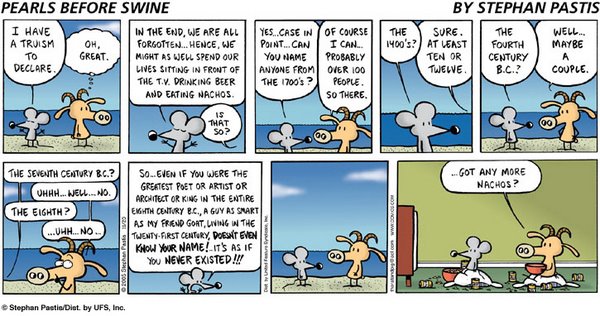
The second item was a quote I got in an email today. It's by the comedian Emo Philips, who I wasn't very familiar with. Turns out he's very funny. Here's his quote:
When I was a kid, I used to pray every night for a new bicycle. Then I realized that the Lord, in his wisdom, didn't work that way. So I just stole one and asked him to forgive me.
Besides being very funny - isn't that incredibly thought provoking? It brings up some very important issues about the nature of both tefila and teshuva.
I've discussed my thoughts about "asking God for a bicycle" a couple of times already. But I recently went to a very intersting shiur where the Rav had a pretty bold - but hard to deny - thesis: that there is no Teshuva before punishment in the Chumash. It appears in the Nevi'im, and certainly in the Oral Torah (and makes its way back into our view of the Torah via midrashim.) But in the punishments of Kayin, the flood, the Tower of Bavel, Sdom, Mitzrayim, the Golden Calf and more - the people getting punished never were given a warning and a chance to repent. Even the section of the Torah which deals with teshuva, in Parshat Nitzavim, only comes after the curses of Ki Tavo.
Of course that approach has changed over time, but that only makes the questions raised by Emo so much more fascinating.
Wednesday, November 16, 2005
The Dilbert Blog: Unfair Stereotypes
Scott Adams, the creator of Dilbert has a new blog. And today he had a rather funny insight into the recent bombings in Jordan:
The Dilbert Blog: Unfair Stereotypes
Sunday, November 13, 2005
The Baby Name Wizard: NameVoyager
Type in your first name and see its distribution over time:
The Baby Name Wizard: NameVoyager
Thursday, November 10, 2005
A logic riddle
Someone posed this logic riddle to me this morning:
If Shimon Peres were to enter a loser contest, would he win or lose?
Saturday, November 05, 2005
at least listen to milo
I have a number of friends and family members who adhere to the Atkins diet. They're convinced that it's a great way to lose weight and stay slim. I have a number of reservations about the approach, but I'm not usually comfortable discussing it with them directly. So I figure, I'll write about it here, and maybe by chance one of them will happen to come across it...
When it comes to losing weight, I always remember the advice from this classic 1987 Bloom County cartoon: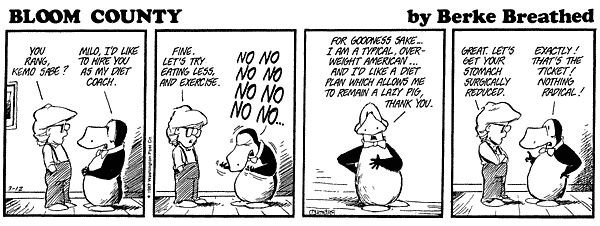
I might add "eat right" to "eat less", but the basic message is incredibly solid.
My weight now is far from ideal, but I have successfully lost weight in the past, and from what I've seen the most important factor (I suppose besides genetics) is will power. (However, as Toad points out here [ignore the footnotes], sometimes a cake is preferrable to will power.) When I have committed myself to eating less and exercise, I've lost weight. When I don't do that - I gain weight. Pretty simple.
Fad diets have been around for a long time, but for some reason Atkins has come across as very attractive.
For the red-blooded American male (or immigrant to Israel) what’s more attractive than a diet that says eat as much meat as you can, and labels carbs as devil’s food (and devil’s food cake as carbs...)?
What’s my problem with it? Well I need to return once again to the 1980s - pre-Atkins. I got a copy of the book Jane Brody’s Good Food Book - Living the High Carbohydrate Way. She paints a picture of how a high carbohydrate diet is the most healthy way to live and will keep weight down as well. It fits well with everything I learned about nutrition and physiology in school.
The misconception that many people have that carbohydrates are fattening stems from the fact that we often put fattening things on top of our starches. But starches, particularly those that are full of fiber, are very healthy, and create a sense of satisfaction that reduces our appetites.
Brody brings many scientific studies that show the advantage of a diet high in fiber and carbohydrates and moderate in proteins and fats. But what convinced me most was her explanation of how man is designed. She entitled the chapter “Dietary Lessons from Human Evolution”. I won’t go into a discussion of evolution, but suffice it to say that if I can conclude that there are lessons from the way God created us, then they are much stronger!
She writes that “our teeth are structured more for grinding, like those of herbivorous cattle, than for tearing meat, like the teeth of carnivorous cats and dogs.” Also, “our long and convoluted intestinal tracts are better designed for the slow digestion of fibrous plant foods, rather than the short, straight, fast tract needed by carnivores to process meat”.
She describes how ancient man had relatively infrequent access to meat, while most of the time would eat starches, fruits and vegetables. When a meat meal would become available, he would eat as much as he could. We still have that passion today, but we end up eating much more meat than necessary. This is also the view of the rabbis, who wrote that “one should not eat meat unless he has an appetite for it (Hullin 84a).”
So instead of working with what the body is supposed to do, a high-meat, low-carb diet basically induces ketosis. That might not seem so bad, but I worked in a refet for a year and a half, and I saw what happened when the cows got bovine ketosis. Not pretty. It doesn’t seem appropriate for a person to bring it upon himself.
Additionally, it would seem that an Atkins type diet isn’t great for the kidneys. This site describes the process:
When amino acids are "burned" as a fuel, ammonia (NH3] is the waste product.
Ammonia must be carried to the liver, converted to urea and excreted by the
kidneys.
(This is why it’s not a good idea to eat protein before a fast. The water you drink beforehand is used to pass the urea instead of helping you out the next day. Carbohydrates, on the other hand, preserve water, making the fast easier. Since I’ve learned this tip, my fasts have been much easier.)
So a very high protein diet makes the kidneys work overtime. That seems like a risk that isn’t worthwhile, even for the chance to lose some weight.
So what do I recommend? If you won’t listen to me, at least listen to Milo…
The Pop vs. Soda Page
With my wife hailing from Chicago, and me having grown up in Rochester and San Francisco, we often have "debates" about the proper terminology for flavored carbonated beverages.
Well, here's a page that discusses in detail the geographic distinctions of that controversy:
The Pop vs. Soda Page
Subscribe to:
Comment Feed (RSS)