Thursday, August 04, 2005

no divine jukebox

Back on Lag B'Omer, I mentioned how I feel that God is not a jukebox "where if you put the right coin in, you'll get want you want." I'd like to develop this a bit more.

As I've discussed in the past, I'm a baal teshuva from around age 16. But as I've also revealed, I'm not the typical NCSY/Aish/Or Sameach baal teshuva type. Most people probably can't guess that I wasn't born religious (unless they ask me which parsha I'm willing to lein in shul.)

My path towards religion was in a strange place - San Francisco, with a non-typical organization - Bnei Akiva, at a difficult age -- 16. There simply wasn't a standard framework for the trek as I imagine many other older people in communities with larger Orthodox populations find. So a lot of the time I had to figure out things on my own. And in the process, I would make "deals" with God - help me with this, and I'll start doing this mitzva. The weird thing is, it worked. All kinds of small "miracles" helped me along the way. But they were rather private (even now I don't feel like discussing the actual details of the deals), and I didn't discuss them with others (although I certainly talked to people quite often about religion in general.)

I don't remember the exact texts I was reading at the time, but I'm sure many of them emphasized the concept of "hashgacha pratit" - (private) divine providence. And my own encounters with the divine probably seemed to confirm that aspect of Judaism for me.

I think the first time I ever started thinking a little differently about things was in Bnei Akiva's program for the summer after 11th grade - TVI (Torah V'Avodah Institute). We had a number of interesting guest speakers that summer, one of whom was Rabbi Yitz Greenberg. I haven't been a huge fan of him since, but I do remember him discussing an interesting topic to a small group of us one shabbat afternoon. He was talking about the history of the Jews interaction with God, from the giving of the Torah at Sinai, to the period of the prophets, until today. And in what seemed somewhat counterintuitive at the time, he proposed that the constantly decreasing level of prophecy over the ages was actually a sign of progress. As we (the Jewish people) became more mature, we needed direct signs of God's involvement in the world less, such as miracles and prophecy. We were able to do the mitzvot from a point of free will, to choose the path based on it being the right thing to do, not something we couldn't avoid from Heaven.

Later, this concept became even more clear to me after learning with my Rosh Yeshiva, Rav David Bigman. I remember early on in the first year of my yeshiva talking to him about something related to hashgacha pratit, and he said that while without a doubt it exists, you can't use it as proof to others. This theologically confirmed what I had felt in my dealing days. During my time in yeshiva I began to study the works of Rav Soloveitchik for the first time, and merited to learn them with some of his students, particularly Avram Stein. The Rav took a much more advanced approach to questions of good and evil in the world than I had ever seen before.

One pivotal moment for me was when Rav Bigman found me photocopying a section of Rav Eliyahu Dessler's Michtav M'Eliyahu. He picked up the book, looked at it, and told me, "I read that book, but he told me that by keeping the Torah I'd be happy, and I'm not always happy, so I stopped reading it." He was referring to the first chapter (which I had read in my early days of being religious and perhaps it had an effect on me then). Rav Dessler explains how everyone wants a happy life, but neither the rich nor the poor are guaranteed one. He then goes on to show that only the people observing Torah are happy. He writes

"The one who enjoys a rich spiritual life is happy. There is no other kind of happiness in existence...Happiness is when the goals are obtainable..The more energy, the more drive, we put into attaining these goals, the happier we shall be."

This is in stark contrast to Rav Soloveitchik, who writes in the famous footnote #4 of Halachic Man writes:

Religion is not, at the outset, a refuge of grace and mercy for the despondent and desperate, an enchanted stream for crushed spirits, but a raging, clamorous torrent of man's consciousness with all its crises, pangs and torments.

And in his essay Sacred and Profane he goes beyond the footnote, and declares:

The error of modern representatives of religion is that they promise their congregants the solution to all the problems of life -- an expectation that religion does not fulfill. Religion, on the contrary, deepens the problems but never intends to solve them.

He goes on to describe holiness as a paradox, not a paradise.

I can't imagine how I would have handled such ideas had I gone through the popular paths of baalei teshuva. Most likely, I would have simply chosen Rav Dessler over Rav Soloveitchik.

But I didn't. And by studying the Rav's Kol Dodi Dofek, I began to understand how this approach to religion translates into his understanding of history as well. If the Torah is guaranteed to make us happy, as Rav Dessler would claim, how do you explain the deaths of so many Torah observant Jews in the Holocaust? The only choice is to somehow explain or justify the Holocaust so it fits in a larger divine plan of reward and punishment. But if we understand that there are no promises, that we might end up not happy, then we don't need to explain the Holocaust, a tragedy so vast that it defies explanation. To do so would be to claim to understand the divine, something we simply can not do.

If Kol Dodi Dofek says we can't claim to understand the purpose of evil via the Holocaust, then Rav Lichtenstein's article L'Birura Shel Midat HaBitachon explores the flip side of that issue. He discusses how we can't claim to know God's plans for good, simply due to the fact that we have been worthy of receiving a State and all the accompanying miracles. Both essays reject the divine jukebox theory, since if we really can't understand God's plans, how can we know which coins to put in to get certain songs?

I'm obviously doing disservice to Rav Soloveitchik's essays, and Rav Lichtenstein's article, by quoting them so briefly. If you haven't read them, it's really important to do so. But if I'm already on a roll, I'll do it just a bit more with two other important thinkers. If we follow the Rav's ideas to an extreme, we'll end up very close to Prof. Leibowitz. For him, any attempt to understand the reason for any of the mitzvot is basically idolatry. While many of his ideas are fascinating, I'm not really pulled in by them. While he does a good job of disproving those who make all sorts of claims to the benefits of keeping mitzvot - both physical and spiritual - I think Judaism is too diverse a religion to claim that those views have no basis whatsoever.

On the other hand, in more recent years I've grown to admire strongly the works of Rabbi David Hartman. First of all, his books that I've read do a great job of describing many different approaches to Judaism. And what's even more interesting to me, that despite his being a student of Rav Soloveitchik, he does a very good job of (respectfully) challenging the Rav's approach. Hartman claims that for Rav Soloveitchik (as well as Leibowitz) the Akeda is the ultimate religious act. But Hartman claims that the covenental experience at Sinai was even more significant. For the Akeda was one way, but Sinai was both sides coming together to make a brit, a covenant. That, along with many other things he writes, ring very true to my ears. So again, I'm doing a disservice to Hartman as well. If this sounds at all interesting, please read A Living Covenant.

Where does all of this leave me? Often confused, but somehow relieved at my confusion. For if I wasn't confused when facing the divine, I'd either be a liar or a fool.

(This post is already much longer than I intended. In a future post I'll discuss how all this affects my views on popular religious jukebox activity, such as saying Tehillim for certain benefits, and particularly in regards to the current religious approach to the disengagement plan.)

Google Site Galleries

This is a nice tip on how to search for all the images on a particular site:

Google Site Galleries

Wednesday, August 03, 2005

working for peanuts

There's a weird phenomenon in Israel that things that aren't particularly American are called "American."

For example, kipot that have a lot of colors, with no solid "base", are called American. (Like these.) I never saw those in America, only here.

T-shirts with sleeves that are different color than the torso, and go slightly past the elbow, are called American T-shirts. Here's an example. I never wore one growing up in the US.

And for some very strange reason, multiple choice tests are called American as well. While I do admit to taking such tests back in the States, I can't imagine that somehow they are unique to America.

But there is one non-American "American" product that I wish they had around back in the old country.

American Peanuts.

American peanuts are a snack that I really enjoy.
Actually, they're a guilty pleasure.
Maybe I should call them the bane of my existence!

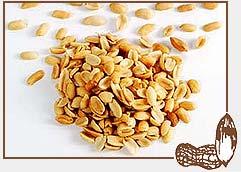
First of all, what are American Peanuts? I got the following great pictures here.

American peanuts are roasted peanuts coated in batter. (Certainly chametz on pesach!) They are both sweet and salty, and very addictive. There are a few kinds:

These are coated with a thick batter, and are known as kabukim (or kibukim):


There are also kabukim covered with sesame seeds:


But my favorite is the simply "botnim amerikaim", coated peanuts:


At my work, my office is right across the hall from the cafeteria. That is certainly tempting, but my hunger is often matched by my basic laziness to get in line and purchase something (not to speak of the relatively high cost of a small snack.)

But about a year ago, they put a coated peanut dispenser in the hall. For one shekel, I get a handful of the sweet salty goodness that is somehow American peanuts! For you Americans out there - that's less than a quarter! Plus, no lines, and it's open 24/7 (unlike the cafeteria).

So I have been known to nosh on these treats here and there (and there and here.) This has not made my watching weight any easier. So it's kind of a love/hate thing. When they weren't available after Pesach, I felt better about myself for not eating them. But of course when I actually eat them, I feel great too!

So how was I supposed to feel today, when I looked through the glass of the dispenser and saw these?


Plain old roasted peanuts! What am I - some kind of plain roasted peanut eating, not wanting coated peanuts animal? I should come to work for this?

Bottom line, I'll probably end up eating the boring peanuts. But I won't like it. Yet, hope springs eternal ...

Sunday, July 31, 2005

HaAretz Natan L'Bnei Adam?

A side issue that I've found interesting in this whole disengagement brouhaha is that the most fascinating interviews and articles recently have been by or about rabbis. And even more interesting is that these articles haven't been in the two major dailies (Maariv and Yediot) or even the more right wing and religious friendly Jerusalem Post. Where can you read about rabbis? In the flagship of the left wing, secular elite - HaAretz.

I'm not sure if this is due to the religious background of the current editor-in-chief, David Landau, or maybe it's connected to the reporters themselves. In any case, there have been interesting interviews recently with Rav Yoel Bin-Nun and Rav Benny Lau. HaAretz also printed Rav Aharon Lichtenstein's piece about refusing orders. And the most recent post to create waves both in Israel and in the blogging world was with Rav Yaakov Meidan. I don't agree with everything he wrote, especially about the part about joining the Haredi world. (This seems particularly strange when the UTJ is sitting with Sharon in the government now.) I also remember Rav Meidan mentioning in a previous HaAretz interview (that I can't find online now) a parallel to a driver coming at you on in the wrong lane. He's wrong, you're right, but if he's coming straight at you, you need to get off the road, even driving into a ditch, in order to avoid a crash. The analogy was that while what Sharon is doing is wrong, we have to be responsible, and take our car off the road to avoid the crash. The more recent article takes a slightly different approach.

What I think is most new about this trend of HaAretz interviewing rabbis is that the other papers now have a need to play catch-up, and discuss these interviews in their own editorials and columns. In other words, the interviews themselves are becoming news.

That's what happened this week in the Jerusalem Post. Amotz Asa-el wrote an op-ed entitled, Rabbi Medan Joins Mapam. It's based on the recent HaAretz interview. I think Asa-el goes a bit far, and Rav Meidan is not nearly as extreme or messianic as Asa-el makes him out to be. And I'm sure someone who uses historical parallels as often as Asa-el does knows that Meidan wasn't being literal when he referred to a "idolatrous city".

But he does bring up a few interesting questions. Have we isolated ourselves so much that the rest of the State has a right to view us as a dangerous outside element (to their worldview?) Is Feiglinism really showing anything else? I'm not saying that revolutionaries don't have a right to say the revolution has started, but it is important to be honest about it. And every revolutionary needs to know that it is the responsibility of the establishment to put down revolutions.

Also, are we being honest when we act shocked about the disengagement plan and the very idea to uproot settlements? Tachlis, the left has been talking about this since Peel in 1937.

I don't think we should be leaving Gaza - at least not like this. But there's a real lack of historical and intellectual honesty in our camp that sometimes makes it hard for me to identify with it.

Thursday, July 28, 2005

an important article

This is an important article to understand halacha, and I'm glad to see it's online.

Rupture and Reconstruction - Haym Soloveitchik

Wednesday, July 27, 2005

what happened to the Northern Shomron?

No one talks about the Northern Shomron (NS). Everyone is talking about Gush Katif (GK). Why?

There are more people in GK than in NS, but I don't think that's the reason. My gut feeling is that precisely because GK is less integrally part of Eretz Yisrael than NS, the focus is on GK. In other words, by focusing on GK, the anti-disengagement movement is saying "we are opposed to giving up any part of Eretz Yisrael - look how much we fight for GK."

But bottom line, NS is much more important, even if there are less yishuvim. They are the heartland of the country. I'm concerned that by not putting a real fight there, if as likely the pullout goes through as planned, it will be much easier to pull out of small sections of Yehuda and Shomron.

But I haven't heard anyone say that NS is more important than GK. Is it too late?

Tuesday, July 26, 2005

thinking japanese

We went out to dinner at one of my favorite restaurants last night, Yoko Uno, in Tel Aviv. It's a kosher Japanese restaurant with fantastic sushi, soups, pasta and fish dishes. In my pre-kosher days in San Francisco, Japanese food was probably my favorite. There were these great soup restaurants where a bowl of miso soup with udon noodles, chicken, vegetables, eggs, etc would fill you up for an entire meal. It took me longer to enjoy Chinese food, but Japanese food always seemed more clear, more distinct than the mish-mash of Chinese stir-fry (which I love now.) It fit well in with my personality (you can pick analytic or any part of that word for the adjective.)

In a similar way, I preferred Japantown to Chinatown. Instead of small chochkey shops like in Chinatown, Japan town had stores with high technology items, and a cool modern movie theater.

All of this fascination with Japanese culture led me to an unusual choice in high school. I went to a large high school, so we had access to a wide variety of courses in every field. When it came to my foreign language requirement - I chose Japanese. In the beginning I enjoyed it, but by the third semester, I was sitting in class simply writing "I hate this" over and over again in my notebook.

This essay describes the experience perfectly: So You Want to Learn Japanese

Luckily, the size of the school that gave me the opportunity to take Japanese, also provided my salvation: I switched to Hebrew (in public school!) in the second semester of 11th grade. The difference couldn't be greater. In Japanese we had unending rules about addressing the teacher politely. In Hebrew the teacher went by his first name and we spent the whole class shmoozing.

I ended up forgetting how to read and write in Japanese within a few months of dropping the course. And now I only remember a few words. I regret it in the sense that it would be cool to know the language, but it's certainly not something I need on a daily basis.

What I do need on a daily basis is udon miso soup...

ever wonder why there's no cent sign on computer keyboards?

The Demise of the $.01 Sign

Monday, July 25, 2005

Me and Sports (yeah, right)

I was never good at sports. I never particularly enjoyed watching sports either. When I didn't have to play or watch any more, I never looked back. Although this sometimes puts me at a social disadvantage when people are talking about "the game", I think I can handle it.

But I thought this would be a good opportunity for me to review some various sports and my relationship with them:


  • Baseball: My family was always very into baseball. My grandmother started going to Red Sox games in 1925, and is still a huge fan. One story was how a neighbor heard her yelling and cursing and thought my grandfather was beating her. It turned out that he wasn't even home - she was yelling at a game on TV! My uncle loved baseball so much he ended up the president of a minor league baseball team. And in high school, my father used to bring home major league baseball players to play stickball with him and his friends.

    What about me? Well, I "had" to play little league. I was terrible. I think the experience is best described by one of my favorite comedians, Brian Regan:
    Lousy in Little League
  • Basketball: This sport I actually enjoyed playing a bit as a kid, even though I wasn't any good. But again, my family had a better connection than me. My father, for example, went to the same university as Julius Erving "Dr. J" - and they even played ball together.
  • Football: While I'm sure I must have, I don't remember ever really playing football. But it was an important game to watch. I remember being very bored on Sundays watching my family watch football. (Although the commercials on the Superbowl were fun). One big difference between football and baseball/basketball was that it was relatively easy to get tickets to the later in San Francisco, and almost impossible to the former. The only game I ever went to was a 49ers championship game, with 50 yard line seats. My father only needed to trade 2 airplane tickets to Hawaii...
  • Soccer: Boring. No interest in following it at all here. First of all it doesn't seem to have seasons - somehow it goes on all year round. And it reminds me of garinim (sunflower seeds) - way too much effort for such few results.
  • Hockey: I never played ice hockey. (Can't skate.) Floor hockey was fun in 6th grade, but haven't played since. But one game, although it's difficult to call it a sport, that I do like - air hockey. I'm actually not bad, and love to play it whenever I get a chance. Maybe some day I'll have a table at home...
  • Wrestling: This is the family sport. There was a saying in my family "Girls play volleyball, boys play football, men wrestle." My father, and brothers all wrestled in school, and my cousin nearly went to the Olympics. I never followed through like them, except for one day in high school when I thought of joining the team. Then I realized how much work was actually needed to prepare, and that ended as fast as it started.
  • Boxing: My grandfather was a boxer in the 1920s. At the time it was a very Jewish sport. He was called "Killer Cohen". But his career didn't last long. Mine was even shorter. For some crazy reason, in 5th or 6th grade, we were allowed to box, in the locker room, under the auspices of the gym teacher. I had a rival, we boxed (with no training), my head hit the wall, and I passed out. Never took that up again...
  • Volleyball: Nothing much to add here except that when I first came to Israel, I couldn't figure out why Israelis play it with their nose (if you know the Hebrew word for it, you'll understand)
  • Athletics: We had decathlon every year in 5th and 6th grades. I got hit in the teeth by a discus. Still have the marks on my teeth.
  • Golf: My brother loves golf. The closest I ever came was when we learned it in high school (it used to drive the soccer team crazy, since we practiced on their field) and miniature golf - which I'm not very good at, but have occasionally had rather good luck.

Sunday, July 24, 2005

one of the funniest things ever to ever grace the internet

SatireWire | Feature: Interview with the Search Engine

Friday, July 22, 2005

armchair quarterbacks of efrat

I subscribe to the email discussion list of my town Efrat. Despite the political moderation which Efrat (and Gush Etzion) is known for, there is often a sense of groupthink, mob mentality on the list. Sometimes I respond to issues brought up, but now temperatures and tempers are rising, and I think I'd prefer to bring up the points here, instead of on the list.

Two things:

  • Rabbi Riskin was attacked publicly for supporting a new fund designed to help the families who are set to be evacuated from Gush Katif later this summer. He was accused of demoralizing the public, admitting defeat, conceding to the enemy, etc. Besides the fact that I would hope that people here could respect opinion different from their own, I think that the approach that says we should avoid thinking about the "day after" because we hope it won't come - isn't very Jewish. We're the most pragmatic religion out there, and that's why we've survived for so long in so many difficult situations.

    I think a good example of this is something that happened recently in our shul. We've been davening there less than a year, and Tisha B'Av is coming up. Should we buy kinot? In principle, it's one of the 13 principles to believe that Mashiach will come daily. (I think that's even more of a core belief than the need to keep any given section of Eretz Yisrael, at least according to the Rambam). Is purchasing kinot before Tisha B'Av admitting defeat? Are we conceding that Mashiach won't come? Of course not. We believe that mashiach will come, but we still prepare for the future, based on what seems most likely to us now.

    (An interesting halachic side - if someone comes to Israel from Chutz L'Aretz for a visit, how can they keep two days of chag? If they believe Mashiach will come before they leave, then they will de facto make aliya and only need to keep one day. So by keeping two days, they're declaring that Mashiach won't come before they leave. I've heard this in the name of a number of rabbis, but never seen it actually printed anywhere.)
  • Today a number of people on the list got angry at the heads of Moetzet Yesha for calling off the march to Gush Katif which ended in Kfar Maimon. "Failed leadership", they decry. This really bugs me. It's one thing to say that Labor leaders like Peres, Rabin, Barak aren't good people despite all they've contributed to the State. They can easily ignore all Sharon has done for the settlements because of his current plan. If any politician strays from the path, no matter how far right they are (Bibi, Rav Benny Elon, Orlev, etc) they are in for a real lashing by the ones who really know on the Efrat list.
    So who's next? Moetzet Yesha. This is weird to me primarily because if these people really wanted to ignore the decisions of the Moetzet Yesha leadership, they could have simply stayed in Kfar Maimon. But at some point will they have the humility to say, that perhaps, just perhaps, if they were in a position of leadership, where they'd need to actually make decisions, they might end up doing something different than they think now? Or does that sound too much like "What you see from here you don't see from there..."?

Thursday, July 21, 2005

the joke still fits

Condoleezza Rice is coming to visit today, and I'm reminded of this old joke:

On one of his trips to China, Henry Kissinger was presented with silk fabric by one of the Chinese diplomats. Kissinger went to several tailors who all told him that there wasn't enough fabric in order to make a suit for him. Finally, he went to a tailor in the strictly-Orthodox neighborhood of Mea Shearim in Jerusalem. There the tailor took Kissinger's measurements and assured him that not only would he be able to make a suit for him, there would even be enough fabric to make an extra pair of pants. Kissinger asked the tailor how this could be, when afterall, several other tailors had told him that there wasn't even enough fabric for a suit. The tailor replied, "That's because by them you're a very big man. By us, you're not so big."

it's nice to see a company that doesn't take itself too seriously

Google Copernicus Center

Wednesday, July 20, 2005

A powerful article by Rav Aharon Lichtenstien

Reflections on decisive times and decisive orders

Tuesday, July 19, 2005

Now this is a great cellphone accessory...

ThinkGeek :: Retro Phone Handset

Monday, July 18, 2005

What I'm reading presently

Duh.

Wednesday, July 13, 2005

My daily web jog

I thought I'd share my daily web habits. I like "jog" better than surfing or browsing, since it's more of a regular routine, like a jog around the neighborhood. (Actually, I don't ever really "jog" - at most a brisk walk. During the last local elections, someone asked me if I "was running" - which in Hebrew is the same as "do you run". I said, "look at me, does it look like I run?")

I've been using the internet for quite a while, back to around 1993. For a while I used bookmarks/favorites to mark those sites where I wanted to return to visit often. But recently, I've begun taking advantage of the wonderful technology of RSS, which allows you to "subscribe" to web sites that publicize their changes. Some people use software to read their RSS feeds, but I prefer web based, since I check them both at home and work. So the first site I visit is My Yahoo! which contains many (most?) of the sites that I visit daily. It's very convienent, since I can very quickly see which sites have new content.

So on My Yahoo!, what do I check? First, the news. Ynet is the only Israeli site with an RSS feed of their own. But I also visit HaAretz regularly. And when I want to follow a breaking news story, or just see what's been going on in the past hour or so, I go to Fresh. Fresh has up to the minute headlines from most Israeli news sources (in Hebrew.) My Yahoo also has headlines from Reuters, so I can keep up with what's going on in the rest of the world.

Then comes the blogs. My regulars:


  • Chayyei Sarah. In a way, this one got me interested in the world of blogging. We have a common friend in Jerusalem, and when we had a shabbat meal together, she mentioned something (which I've long forgotten) that I wanted to lookup after shabbat. When I tried finding it on Google, I came across her blog, which led me to others, which led me to starting my own, etc.
  • Lamed. Lamed is run by a friend, neighbor and teacher, and on a daily basis has an interesting link about something in the Jewish and/or educational world.
  • An Unsealed Room. I've been following Allison Kaplan Sommer since the Gulf War (before she was a Sommer). I've always enjoyed her writing, and was pleased to come across her blog when I was looking for gossip about the management changes at the Jerusalem Post.
  • Treppenwitz. We live in the same town, although I don't think we've ever met. Constantly good writing, daily updates, interesting pictures, and often gives me cause to comment. A real leader in this field.
  • Ben Chorin. Another fellow resident (although this one I've finally met!). A fascinating thinker with much to say. After hearing him speak in public, I'm even more impressed. He's leading some amazing changes in this country - someone to watch.
  • Bloghead and Hirhurim. These two are so prolific and update their blogs so much, that I can't read every post. But to follow trends in the Jewish world, you can count on them.
  • The Slumbering Lungfish. Lore Fitzgerlad Sjoberg deserves (and I hope will get) a post of his own. Perhaps the funniest guy on the internet. I used to await weekly his new Ratings, but now that it's not being updated (although, Lore, if you read this, it's never too late to start again), I can still count on his blog to make me laugh.

Now what's the daily papers without the comics? I've always been a loyal reader of the comics (my dad and I used to fight in the morning about who would read them first.) Here are my regulars:

  • Dilbert
  • Doonesbury
  • Pearls Before Swine
  • Speed Bump
  • Fox Trot
  • Mr. Boffo

A daily site for me that's not on My Yahoo is Newsmax's Liners. They quote most of the jokes from the monolouges of talk show hosts like Leno, Letterman and Conan. Besides being funny, this is one of the best ways for me to keep up with current events in the US. When I read the news I find out about what's imporant. When I read the Liners, I find out about what people are talking about.

Some sites I visit are updated weekly, and I can remember what day of the week it is by what's coming out that day (or is it the other way around?):

  • Sunday: The New York Times Sunday Magazine. While there are often a number of interesting articles, I need to read William Safire's On Language column.
  • Wednesday: The Onion The classic satirical magazine. While some pieces fall flat, there's always a few that hit the bullseye.
  • Friday: Cecil Adams' column, The Straight Dope. The expert on everything, never ceases to enlighten the teeming millions.

All this is in addition to to the dozens of columns about computer news that I read for proffesional enrichment. Without RSS, I can't imagine how long it would take me to go to all those sites!

Tuesday, July 12, 2005

there is a fish...

I got an email from the Exploratorium yesterday, telling me about the exhibit I mentioned here.

Check out the New Yorker piece in particular, it really describes the experience.

Subliminary Artworks by Bill Bell

Sunday, July 10, 2005

I saw the fish ... again

In January of 1990, I went on a Bnei Akiva shabbaton in NYC. On Saturday night, we went to some sort of mall on the ground level of the World Trade Center. There was some activity planned for all of us. We all spread around the area. At one point, out of the corner of my eye, I saw a giant red fish floating in the middle of the air. I turned around and it was gone. I thought I must have been seeing things, so I forgot about it, until it happened again. When that happened, I ran to tell one of the participants on the shabbaton. She thought I was crazy. By this point I realized that if I turned my head really quick, I could cause the images to appear. There were other images besides the fish - a basketball player, for example. Finally, after bothering both friends and people who on the shabbaton who had only known me for about a day, someone else saw the fish. And to the consternation of the counselors on the shabbaton (who wanted everyone to participate in the activity), eventually almost everyone saw the fish.

It turned out it was a borrowed exhibit from the amazing science museum in San Francisco, the Exploratorium. I haven't been able to find anything online explaining the exhibit, but what I recall was that you were meant to use mirrors, because then you'd see the floating images clearly. But you could see them briefly without the use of mirrors.

For a long time afterwards, every time I thought I knew or saw something that no one else could see, where they thought I was crazy but I knew I was right, I called "seeing the fish".

I hadn't thought about that incident for a long time until recently, when I started playing with Google Earth. One of the neat things about the program, is how you can find all sorts of things from above that no one would ever see on land. Through the supporting online forums, I've found shapes that people mowed in to fields, or placed in the middle of the desert. Pretty amazing stuff, when you think you can see it from a satellite.

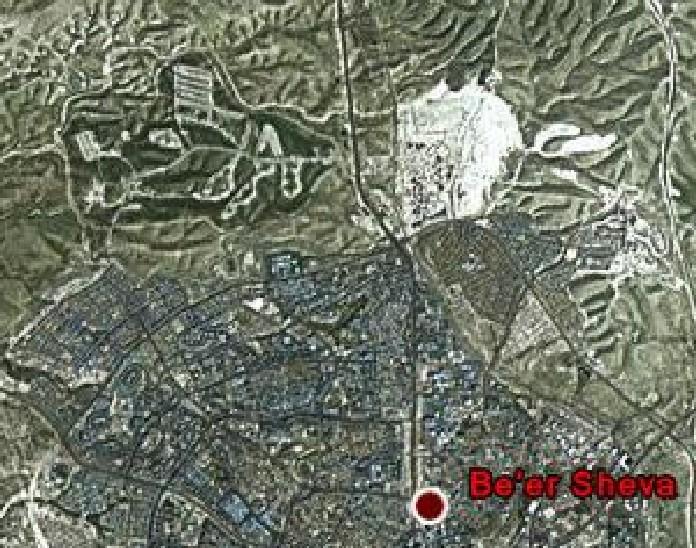
Well, I thought I found my own version of one of these man-made shapes when I was looking around the satellite images of Israel. Just north of Beersheva, I saw this:

It's a pretty unusual shape, no?

So I called up a friend from Beersheva, to ask what she thought it was.

She had no idea.

She thought I was crazy.

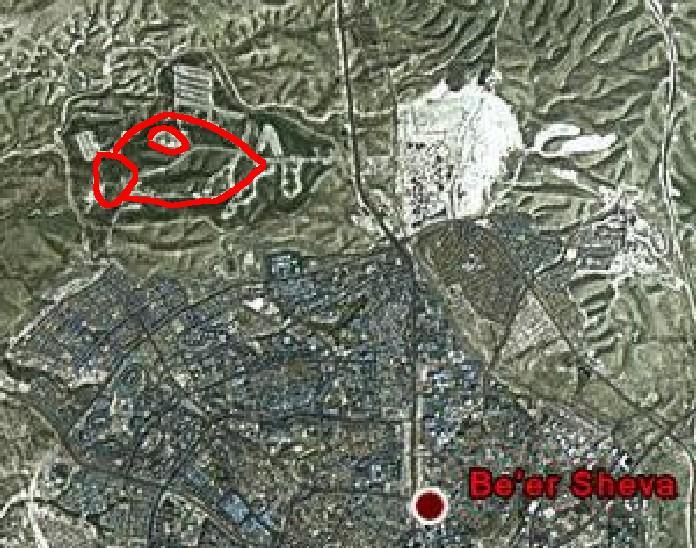
Finally, I used a program online, where we could both see the same image, and I could "draw" on top of it.


I showed her this:

See it?

It's a fish!

I admit it's a strange fish.

With legs. And a lawn chair on it's back.

But it's still a fish.

And while I was trying to "prove" what I saw, I started laughing.

Because her husband was on that shabbaton!

Of course when I asked him if he saw the fish, he thought I was talking about that night 15 years ago.

And he still doesn't see the fish in the picture.

Do you?

Thursday, July 07, 2005

My country 'tis of thee

According to this article in HaAretz, 500,000 American Jews could immigrate to Israel in the next 15 years. Obviously, this would have dramatic implications for life here in Israel.

Here are my top ten predictions for how life will change:

  1. On the bills and coins will actually be printed, "In God We Trust"
  2. Monday will become the most dreaded day of the week
  3. Knitting clubs will become popular to utilize all the time freed up from the cancellation of movie intermissions
  4. Instead of multiparty political chaos - two party gridlock
  5. IDT will replace Bezeq as the national phone carrier, but will be forced to open call centers in Los Angeles to find Hebrew speakers
  6. Yoni Leibowitz will become Israel's most popular talk show host (no more "Jon Stewart" for him!)
  7. Difficult to pronounce "resh" will be replaced by the new letter "thoth"
  8. Football = Football
  9. Coca-Cola will be the most popular soft-drink (uh, wait...)
  10. 24 Hour Weather Channel hosted exclusively by Robert Olinsky

Wednesday, July 06, 2005

What I'm reading currently...

I'm again reading a few things concurrently:


  1. The Jews of Lithuania: A History of a Remarkable Community 1316-1945 by Masha Greenbaum. My entire family comes from Lithuania - the small shtetls of Jonava, Seduva, Skaudvile, Vilkomir (Ukmerge), Anyksciai, Balbieriskis and others. I've done a lot of research about my families' history, and I generally consider myself well-versed in world history. But when I finally started reading this book I bought a couple of years ago, I was surprised to see how much I didn't know about Lithuanian history in general, the Jewish community in particular, and how it likely impacted my ancestors. What I find particularly interesting is how unique Lithuania was. They were the last country in Europe to adopt Christianity, and for centuries treated all the churches with suspicion. This led to fairly good relations with the Jews. I also didn't know just how recent the Russian conquest of the Lithuania was - only from 1795-1917. Before that no Jews lived in Russia. And those Russians Czars were bad - really bad. Lithuania also had a pretty decent democracy between WWI and WWII (for at least the first 10 years or so) and the Jews got much more autonomy than anywhere else in Europe. But for all the ups and downs in the book, I know that the story is going to end very badly. I'm in the chapter just preceding the Nazi invasion (another piece of history I knew little about was the Soviet occupation of Lithuania from 1939-1941). While most of my relatives came to the States between 1880-1910, some still remained after WWI. I can't imagine the horror that must have come from realizing their chance for democratic Jewish autonomy in Lithuania would end up in the worst crime in human history.
  2. Abba Eban: An Autobiography I don't think I've ever read an autobiography before, at least as an adult. The book is very detailed (I've read probably 150 pages and the State hasn't been declared yet), but I'm getting a very interesting view of one of Israel's most important diplomats. (His family was from Lithuania, which gives a little connection to the book above.) As with the biography of Chaim Weizmann, and the history of the Etzel, I'm getting another new perspective on the pre-State period. For all the difficulties, it still seems like one of the most interesting times in history to live. Since the book goes up to 1977, I imagine I'll also get new insights on the early years of the State as well. I wouldn't have expected it, but I'm also really enjoying the occasional bits of sharp British humor.
  3. Mishnayot: Masechet Shabbat. As I wrote earlier, I finished Seder Zraim on Shavuot. So now I'm going through a more relevant seder: Moed. This was actually the first pocket mishnayot that I bought - back in the army. I never got far into it then - my Hebrew wasn't good enough. This time I should be able to finish - even if it takes months...

Tuesday, July 05, 2005

it's true because it's funny

We took the kids to see the movie Madagascar yesterday. It wasn't the best animated movie I've ever seen, and maybe was less fun for the adults than some of the Pixar movies. But there was silly, slapstick comedy.

And the kids loved it. I don't think there's anything more authentic than hearing a 6 year old or an 8 year old laugh out loud at a movie. They weren't holding back, trying to be cool or cynical or anything. Just enjoying themselves watching animals do silly things on the screen.

At one point my older daughter leaned over to me and whispered, "Abba, this is just right for us."

It reminds me of the following saying by the Hassidic Rebbe, R' Simcha Bunim:


Three things can be learned from a child:

  1. The child is happy at just being alive.
  2. The child is always active and never bored.
  3. The child always cries for everything it needs.

So too we should serve God with joy, we should always be performing mitzvot, and we should implore God with tears for everything we need.

Sunday, July 03, 2005

Opportunities...

Tonight was the last show of the season of Yair Lapid's talk show. It's a light, popular show - kind of like a cross between Leno and Oprah (although Lapid himself doesn't do comedy.) If it wasn't on one week, or even was cancelled, it would make no difference in my life at all. But sometimes there are things on the show that people talk about on the following day at work.

But for all of its insignificance, I can't help thinking about all those people I used to be in Bnei Akiva with. They keep Shabbat like I do. They visit here. They might even still believe in the same ideology. But they don't know who Yair Lapid is. And somehow that shows how they've passed up the opportunity to join up with their people here.

**********************************************

My son led "Anim Zmirot" for the first time this Shabbat. I'm really proud of him. He basically took it upon himself and practiced both at home and at school. When I was his age I certainly couldn't. (Hell, when I was a senior in high school and asked to do Anim Zmirot at a shabbaton, I couldn't!) I'm already thinking about how with some more practice, he could lead Pesukei D'Zimra or Kabbalat Shabbat (even before his bar mitzva).

But for all the significance of this milestone, I can't help but thinking about my girls. Will they have the opportunity to find a role for themselves in shul? Will they be able to be proud of themselves the way my son can?

Saturday, July 02, 2005

I need closure on that saga!

I enjoy a good saga. I don't know if this is the actual definition of a saga, but I'm referring to a series of books or movies that has a definite end. The James Bond movies, for example, wouldn't be a saga. But the Star Wars movies, especially with the last movie having just come out, fall in that category. After almost 30 years, I now know the whole story.

Another couple of sagas that took me a while to get into, but eventually I enjoyed are Harry Potter and Lord of the Rings. I never read LOTR as a kid (started reading the Hobbit, but never got into it.) But we got the DVD of the first movie a few years ago as a gift. However, the long playing time discouraged me from seeing it. In the end, we finally watched it, and rented the other two, enjoying them. (But I don't think I'm going to read the books.)

My wife had been reading Harry Potter for a while, and I kind of dismissed them as silly. But after she convinced me to read one, I was hooked. With the newest one coming out later this month, I'm not sure how we're going to handle sharing it! Either we'll have to come out with a very sophisticated plan, or maybe we'll just buy two copies...

Another series that I really enjoyed as a kid was Lloyd Alexander's Prydain Chronicles. Except for a terrible Disney cartoon that combined two books and completely distorted the story, there was no movie made. But the books were fascinating, and as a kid I knew everything about them. I even corresponded, and later met Lloyd Alexander. When we were in the States last summer, I bought the series, and am waiting for my kids to get a little older, so I can read it to them (or perhaps they'll read it themselves.)

One series that I read as a kid, and now is about to be made into a movie, is C.S. Lewis's The Chronicles of Narnia. Probably in 5th or 6th grade I read the entire series, but something always seemed uncomfortable for me. I can't remember anything about the plot now, but I do remember thinking even then that the book seemed much too Christian for me. This has always been a bit strange for me, but even when I wasn't religious, and even as a young kid, Christianity always made me uncomfortable. In 5th grade I went to Spain with my father, and I couldn't stay inside the world famous Prado museum because of the Christian art. I recall even at a younger age being in an after-school program at a Church and being very upset at having Christianity discussed with me. And I don't remember this story, but my parents have told me that as a baby I urinated on the floor of a convent!

In any case, when I heard about the upcoming movie, I went online to see if my memories of the story were accurate. I found this very disturbing article:

Disney finds religion for its Chronicles of Narnia

There seems to be an antisemitic undercurrent by some of the supporters of the movie. I think this might be one saga I can pass up on...

Friday, July 01, 2005

don't break the (nuclear) wessels...

I'm concerned about the protests over the disengagement.

I'm not talking about their effectiveness (although I don't really see who exactly the road blockings are going to convince, and how that will change the government's plan) or the specific tactics. I'm not even talking about whether the plan should be protested against. (It doesn't seem like a good plan to me, but as I've mentioned before, I think things are usually a little more complicated. Perhaps a reverse Occam's razor?)

I'm concerned about the effects of the protests themselves - regardless of whether the disengagement is blocked.

What's difficult for me, is that if the disengagement is truly unjust (or at least viewed that way by its opponents), then why should I view the protests differently than those against other unjust acts? My cousin was one of the leaders of the Etzel, and planned and carried out many of the attacks against the British. When I read his stories - I fill up with a great sense of pride. I remember myself protesting against the Soviet Union, to let the Jews leave freely leave to Israel. So why is this different? Why can't I identify in the same way?

I think the reason is, that I don't care about the welfare of the British mandate or the Soviet Union. But I do care - very much - about the State of Israel!

What I'm worried about is called in Hebrew "shvirat kelim" - translated as "breaking of vessels". It's a kabbalistic concept, but the modern idiom might be closer to "throwing the baby out with the bathwater". It is often said that it is forbidden to break the vessels - meaning that once the vessel is broken, it can't be repaired. There must be limits - no shvirat kelim.

Another classic example of this is the famous story of the two mothers who came to King Solomon fighting over a baby, each claiming he was hers. When Shlomo offered to cut the baby in half, one mother objected, and the other thought it was fair. The wise king realized that any mother who would cut the baby in half for a cause, who was willing to break the vessels, could not be the real mother.

I think the metaphor is clear, but I'll give one more example that I wrote about recently on an email list:

" I think an appropriate metaphor would be a voyage across the sea. Obviously the focus of the traveler is the sea - not the vehicle. But to cross the sea, you need some vehicle, in this case a boat. Now you can complain about the boat, the crew and the captain, but bottom line, this is the first boat (in our metaphor) to successfully make it to sea in 2000 years. All other attempts - walking across the sea by foot, waiting for the wind to carry one across the sea - didn't work. Now no one would say that the boat doesn't need improvement or can't go off course. But to start drilling a hole in the boat -- well, that very well may lead to the end of the voyage. The unity of the boat must be preserved! We have no other boat!"

What concerns me greatly is that I see more and more people from the Religious Zionist camp who are willing to drill holes in the boat, cut the baby, break the kelim - anything in the name of preventing the disengagement. This approach doesn't surprise me when it comes from the haredim. They don't view the State as a vessel of any intrinsic value. And in fact, in the haredi neighborhoods not far from my work, they've had some of the most active road blocking protests. But we're not Haredim! At least I'm not. (I do know that the late Adir Zik was probably the best examples of someone associated with Religious Zionism who had in the past few years said he could identify more with Haredism. But I don't think it's a real trend in RZ circles - at least not consciously.)

How far will the country go this summer? What will remain?

A few years ago, at the height of the intifada, and also when Israel's water resources were at a dangerous low, a neighbor of mine told me that when she would go to the States, she couldn't relax about the terror situation, because she was always worried that someone she cared about back home might be hurt. But she was relieved about using the water in the States, because it didn't impact the situation in Israel at all. Now I think there's a new category. People are so concerned about the anger level this summer, that if they leave Israel for a vacation they're actually looking forward to not facing the explosive situation.

But maybe things will work out. We obviously have some level of divine supervision happening here - I can only hope that it will prevent us from destroying the most valuable gift we've received in the past 2000 years.

But I don't want to end on a scared note. Here's a great joke related to the metaphor above...


A Jewish town had a shortage of men for wedding purposes, so they had to import men from other towns. One day a groom-to-be arrived on a train, and two mother-in-laws-to-be were waiting for him, each claiming ownership on him. A rabbi was called to solve the problem. After a few minutes of thought, he said: "If this is the situation, you both want the groom, we'll cut him in half and give each one of you half of him." To this replied one woman: "If that's the case, give him to the other woman." The rabbi said: "Do that. The one willing to cut him in half, is the real
mother-in-law!"

Thursday, June 30, 2005

Got the whole world...

This is absolutely amazing. Just leave it to Google. I'm lucky that a) I have a computer at work that can handle it (my home computer doesn't stand a chance) and b) the firewall at work doesn't block it (as it does with most things.)

I was looking all over US and Israel. San Francisco in particular, because then you can see buildings in 3D.

One bummer - the curvy part of Lombard Street isn't really visible...

Monday, June 27, 2005

a few things on my mind...

This past weekend we went away to a hotel for Shabbat. On the way, we stopped off at the kibbutz we used to live on. It was a weird experience, as it usually is for me when I visit places I used to live. I seem to have an obsessive need to return to my "roots". In some cases, as in genealogy, I'm returning to places I've never been. But in others, I go back to cities, schools, homes that I used to live, hoping to find something. Just last night, my friends from my old high school had a big reunion, based on an email alumni list that I created! (Even though I couldn't attend.) I'm constantly trying to keep in touch with people, googling them, trying to maintain a connection.

I'm not sure why. I'm not even entirely sure what I'm looking for. Maybe it's rooted in the fact that my parents divorced when I was young, and I'm always trying to fix distanced relationships. Maybe because I was never terribly popular socially, and by going back, and finding friends, I can improve on the past. Maybe I just figure by going back to my past, I can understand my present and future better.

*************************************

The hotel was nice. We were in Ashkelon, a town on the Mediteranean sea. The hotel room had a great view of the ocean, which reminded me of my house in San Francisco growing up. We lived about 20 blocks from the ocean, on top of a hill, with a perfect view of the Pacific. In the far distance you could see the Farallon Islands, about 27 miles west of the city. Depending on the gullibity of our guests, I'd tell them it was either Hawaii or Japan.

*************************************

Last night my oldest daughter had an end of the year party for second grade. It was almost entirely group singing, particularly songs of a number of Israeli song writers who passed away in the past year - Naomi Shemer, Ehud Manor, Uzi Chitman. To get to the party, we passed by the funeral procession of one of the teenagers who was killed near Beit Hagai on Friday night. The tension on the roads - both of the Israelis who were coming to pay their respects and the Arabs who were waiting to get by - was very clear. But when we got into the room of the party, filled with parents and children, the somber atmosphere soon passed. But it never entirely disappeared, nor did the looming disengagement and potentially explosive summer. As we all sat there, singing optimistic, Zionist songs like Haleluya, Kan Noladti, B'Shana HaBa'ah, and others, I couldn't help wondering if at the end of the summer, we (not only the people in the room, but the country as a whole) would be still able to sing those same songs and believe them. It gave me hope, but also great room for concern. Only time will tell.

Thursday, June 23, 2005

Mitch Hedberg - Wikiquote

This guy is very funny. The language isn't always clean, but the material is. Too bad I never got to see him perform....

Mitch Hedberg - Wikiquote.

Wednesday, June 22, 2005

I'm different...#3

I wasn't originally planning on writing about this yet, but today I realized that one of my "differences" is perhaps more significant than I had earlier thought.

I never finished university; I do not have a degree.

In fact, I barely studied much in university at all.

Now this is different than my first "difference", about not driving. Driving was something that I've always had a difficult time doing, it never seemed to click with me. But as far as learning in general goes, I like it very much and it comes naturally to me. But being a good learner and a good student are two different things.

As a kid, I almost always excelled in my studies. I did well on tests, didn't mind reading, etc. But homework was never my thing. When I put my mind to it I could do it well, but if I didn't pay attention, I could easily end up ignoring or postponing my assignments. I think there were two major issues - my perfectionism and my lack of efficient time management. I would take on big projects, too big, feel like I had to do them perfectly and when it wasn't working out (often due to bad time management - i.e. watching TV instead of doing my homework) I'd give up. The classic example of this for me was my first class of the morning of my first semester of high school - Public Speaking. I did pretty well in the speeches, but when it came to the big final speech, it got to be too much for me, and I started to cut class and go hang out in the park by the school. I failed that course - I'm still embarrassed about it too this day. The rest of my high school academic career went much better - peaking in a nearly 4.0 GPA in my junior year of high school.

But then I found "religion".

When I transferred out of the prestigious academic public school to go to the small Jewish school in my area, I felt like a burden had been taken off of my shoulders. Here was a place where people cared about things other than their transcripts and universities. And when I started yeshiva in Israel the following year, university study was the furthest thing from my mind. I could learn in yeshiva, progress at my own level, and I really enjoyed it. (Although even in yeshiva, I didn't get particularly proficient at skills like gemara learning, but I'll save that for another post.) While my staying in yeshiva for a second year wasn't unusual, by the third year most of my friends went back to the States to learn in Yeshiva University, while I stayed to join the army. (That is definitely material for another post.) I kept thinking - YU - no way! First of all, because I don't like New York, but mostly because if I was going back to the US, I'd give back as much as I could to the movement that got me to Israel - Bnei Akiva.

So after the army, my then fiancé and I moved to Boston. I enrolled at UMass Boston (where both of my parents had attended) and thought that I'd study and work. I signed up for some interesting classes in subjects like politics, history, philosophy. But I couldn't make myself do the work. It was too easy to not go to class, and to focus on the more important issues like my work for Bnei Akiva or whatever TV show happened to be on. At this point, I can't even remember how many courses I actually finished. Certainly not many.

But who cared? We were moving to Israel soon, to realize the dream of every "true" Bnei Akivanik - to move to kibbutz. Kibbutz was perfect in this regard, because they didn't care if you had a college degree, and would likely let me go back to school in the future. And so it went. But in the end the kibbutz didn't work out. And as I realized that, I started to get very scared. What had I done? Why had I wasted my opportunity to get a degree in America?

But again I got lucky. It was the peak (oh so brief) of Israel's hi-tech bubble. And I always had been pretty good at computers, so when we left the kibbutz, I was sent to a computer training course and found a job fairly quickly - without a degree. On my resume I wrote that I studied at the University of Massachusetts, Boston, MA. Which was certainly true. I found out later though that some Israelis had read the MA as a degree, not the state. Certainly no fault of my own. I've always told people about my lack of degree the same way I tell them about not having a license - sheepishly but honestly.

So now I've been working in hi-tech for a few years. But I'm thinking that I really would like to get my degree at some point. Perhaps by studying online, at home. I think I'm more mature now, I think I can handle it. However, it takes money and time, two things I don't have extra of right now.

Mark Twain said: "The first time a student realizes that a little learning is a dangerous thing is when he brings home a poor report card."

I guess I've done a little learning myself....

Monday, June 20, 2005

I seem to be back

I haven't posted for a few days. Kind of a busy week last week. A few things took up a great deal of time:

  • Shavuot. As has often happened in the past, I organized the leil limud in our shul, which obviously mandated me staying up throughout the night. Therefore I made sure I slept the day before, and ended up sleeping a good portion of the following day. I basically ended up giving myself jet lag. I had scheduled for myself to give a siyum on finishing Seder Zraim (which ends with Masechet Bikkurim, particularly appropriate for Shavuot.) It would have been my first siyum ever. Unfortunately there wasn't time, and I didn't get to do it. I don't think I'll have a natural opportunity to do a siyum soon, so maybe I'll try to finish Seder Moed by next Shavuot. In any case, one really nice thing about Shavuot was that we read Megilat Rut at sunrise, and based on the location of our shul, we could see all of Beit Lechem and the hills of Moav. The whole setting of the story, with a beautiful sunrise, right before our eyes.
  • My nephew's brit. It fell on isru chag, but it was actually the second day of chag for my father-in-law, which made the whole thing somewhat complicated. But it was very nice, and after a chalavi Shavuot (which I didn't mind - we had a very good lemon meringue cheescake), having a basari brit, even in the morning, seemed fine.
  • A two day conference in Haifa. This was my first "overnight" trip for, actually with, work. The speeches were fairly boring, but it was nice going away to a hotel. And the food was good. Plus, the hotel was on the beach, and there was a sand sculpture contest. Very cool work. One thing I did realize about myself - I really don't need cable at home. The hotel had something like 50 channels - not a crazy amount, but certainly more than the two I have now. And I kept flipping through the damn thing hoping something good would come on. And of course nothing did. If I had that at home, I'd probably never get to work.

Sunday, June 19, 2005

Pay the parking meter by phone

Brilliant idea. Will it ever make it to Israel?

Wednesday, June 08, 2005

Phil Plait's Bad Astronomy: SPOILER Review: Star Wars: Revenge of the Sith

An interesting review:

Phil Plait's Bad Astronomy: SPOILER Review: Star Wars: Revenge of the Sith

Tuesday, June 07, 2005

Everybody loves a parade

I hadn't planned on it, but after work we took the kids to the Yom Yerushalayim day parade. It was the first time I had been to one since we made aliya almost 9 years ago. In my yeshiva days I would always enjoy it, and I felt the excitement again today. Thousands of people, loud music, dancing, flags all walking toward the Kotel.

Just a couple of notes:

As we walked down Rechov Yafo the crowd got larger and larger. And for some reason I still don't understand, someone (the police?) put up barriers in the middle of the street. The crowd kept progressing eastward, not realizing that they couldn't continue. This started to create very crowded conditions, which the kids did not enjoy. Eventually they opened them up, but the whole thing was very strange.

I did get to tell the kids about a much more crowded situation that I was in once: When I lived in San Francisco in 1987, they held a huge party for the 50th anniversary of the opening of the Golden Gate Bridge. While you can always cross the bridge on the sidewalk, for the event they closed the bridge to cars, and allowed pedestrians to walk in the traffic lanes. Well, I guess they didn't figure that it would attract nearly everyone in the city. Several hundred thousand people showed up - and the bridge is only about a mile long! It was packed. At one point, someone shouted "Lean Left!" and the entire bridge swung to the left. Very scary. The bridge itself actually sagged from the weight:


In any case, the parade today wasn't quite so bad...

The other thing that bugged me today was the protest atmosphere. I know that Yom Yerushalayim is primarily a day for the National Religious public, and there's a lot of opposition to the disengagement plan out there. But I think that Yom Yerushalayim should be a day about thanking God for what we got, and showing recognition to those who helped us get it. Therefore protesting against the government of Israel seems wrong on a day like this.

But despite all that, the focus on the color orange as the main medium of protest. It seems more like color war than serious debate.

I had in my head the following conversation:

Journalist: What do you think about the disengagement plan?

Me:
Well, there are a lot of issues here. On the one hand, you have the demographic problem, the need to preserve a democratic state, the importance of the strategic relationship with the US. On the other hand you have the danger of rewarding and encouraging terror, the precedent of relinquishing our legitimate homeland, the risk of tearing the Israeli society apart. So I think that it's too dangerous of a risk.

Journalist:
What do you think, protest guy?

Protest guy:
I think - ORANGE!

Me:
Isn't that a bit simplistic?

Protest guy:
Come on, it's not like it's a primary color...

Monday, June 06, 2005

Yerushalayim to me

I don't have any deep thoughts today about the significance of Yom Yerushalayim. I guess because I was born after the Six Day War, so I never viewed Israel without all of Yerushalayim.

Outside of a six week period back in the summer of 1991, I've never lived in Yerushalayim. My yeshiva is not in the city, which was unusual back then, and even more unusual today. And since we made aliya we haven't lived in Yerushalayim either.

But I still feel very connected with the city. I've always visited it often. And for the past 5 years I've worked in the city as well.

One of my favorite things about Yerushalayim is how wonderful it is to walk through it. There are great cities in the world where you can't easily walk from one part to another. But Jerusalem, like San Francisco (where I also used to walk a lot) isn't like that. You can really walk from North to South, East to West in one day. And the differences between the neighborhoods are amazing. Often I get a ride to the center of town in the morning, and walk to my office in the eastern part of the city. I walk from the active (well, not so active at 7:30 AM) city center, through the Russian Compound, by the (former?) Ethiopian consulate, through the charedi neighborhoods into the Arab neighborhood of my work. I feel like my passport should be stamped several times a day! And when I really want to treat myself, I take a long walk - let's say from the city center to Talpiot. So many hidden corners, so much to discover.

The other great thing about Yerushalayim for me is how much things are always changing, always building. I mean my first visit to Israel was only in 1988, but I'm already nostalgic for places I saw then, like the old bus station, that no longer exist! The cranes are always moving, the roads are constantly being torn up, new buildings seem to pop up like mushrooms after a rain. Some people here have become frustrated with all the work being done on the new light rail line, but I'm personally very impressed. Despite the economic condition of the country in the past few years, the work didn't stop. It shows a degree of vision not often found in this country. And I'm sure that in a few more years when it's all done, we won't be able to believe we ever lived with out it.

Kind of like how I feel now about the reunification of the city.

Who knows what we'll feel like about that next?

Friday, June 03, 2005

a far too serious look at two movies

I have a friend that I used to taunt about how he had only seen two movies. The movies would change from time to time, but based on how he would refer to movies in conversation, it seemed like he had never seen more than two.

I've never been a huge movie goer, but I would certainly see a decent number of movies in the theater each year (and of course more on video and TV.) But when we moved to Israel, and started having kids, going to the movies became a rare treat. We go probably a couple times a year. One movie will be the annual Pixar flick. That's also the movie the kids see in the theater during the year.

The other movie will be something we've really wanted to see. Back in the summer of 2002, we were in the States for a few weeks, and we saw both Attack of the Clones and the first Spiderman movie. While AotC had sentimental value (we both loved the original Star Wars trilogy as kids), it was Spiderman that really got us. We really loved that movie*.

When Spiderman 2 came out last year, we went to see it in a special early screening for charity in Jerusalem. And then later that summer we saw it in an IMAX theater in the States. It was even better than the first.

And this week we "finally" made it to see the last installment of the Star Wars saga, Revenge of the Sith. I won't discuss the content of the movie, but I did enjoy it, and think it was certainly one of the best of the series.

But today I started thinking about the similarities of both stories. Both feature a young individual who discovers he has special powers, but cannot use his powers to save the life of a close family member. After this loss, he becomes determined to do everything to save the life of the woman he loves, all the while learning to deal with his super powers.

Obviously, Anakin and Peter deal with this challenge in very different ways, and end up on opposite paths. Peter realizes he needs to take on a secret identity to not put Mary Jane at risk, while Anakin ends up getting more and more arrogant, eventually following the path of evil. The lesson of "With great strength comes great responsibility" applies to both of them.

I've been trying to think about the significance of this parallelism. There seems to be no middle way, no chance that Peter could have become a hero without a secret identity, or that Anakin simply could have been a good Jedi. Partly it was because their extraordinary powers made things more extreme, but it was also because they wanted a romance with a "normal" person as well.

Any moral for the real world? Well, I just finished reading the biography of Chaim Weizmann, and here too is the story of someone who in one field had amazing accomplishments, but on the other hand his family life suffered greatly. I'm sure that there are many other cases like this.

I'm sure it seems like I'm taking this all too seriously - we're only talking about movies. But I think great movies, like other works of fiction, resonate with us because hiding behind an incredible story is a truth we can identify with. If we couldn't identify with the challenges the characters face, we wouldn't be pulled in.

And so I suppose that we all face the same challenge on some level. As humans we are on the one hand animals, but on the other hand created in the divine image. How do we handle this dichotomy? Live two separate lives, with two identities, until no one knows that our "Peter" is really "Spiderman"? Abandon our mission and say "Spiderman No More"? Become so obsessed with our powers that we ignore the reality of the world that exists alongside us?

I guess in the end, we're luckier than these fictional heroes. We have a real guidebook to let us know how to balance between the animal and the divine. We don't need to rely on hazy visions or dreams. However, the tension is constant, and it sometimes makes our own lives even more interesting than the best Hollywood blockbuster.


* One of the things that made the movie fun for us, was that despite the fact that we saw it in a very fancy theater, for some reason during the previews, there was no sound. But instead of people getting angry, they just started making their own sound effects. First there was an action movie with a car chase, where everyone was saying "vroooom!". And then came a preview for Scooby Doo, and of course the entire audience was talking like Scooby. When the sound came back (before the end of the credits), everyone was already a little disappointed. While the feeling of seeing a movie with a crowd adds to the experience, you never feel like you're interacting with the person next to you. (I think Rav Soloveitchik touches on this point in Lonely Man of Faith.) Here we had a chance to all work together. Really special.

Tuesday, May 31, 2005

Google really is a Search Engine....

...they actually found Carmen Sandiego!

Stay Cool, Oscar...

Oscar Brown Jr. has died at age 78.

From the Washington Post

From the New York Times

I found out from these articles that Oscar Brown Jr was a social activist, but I just knew him as a great musician. I'm not sure how my father discovered him, but my father would play me his songs as a kid, and I loved them.

He could be funny with Signifyin Monkey, The Snake and Stay Cool.
And I don't think any song shows more the love between a parent and child than "Dat Dere".

He even wrote a cool song about the internet, "Cyberspace is the Place" in the early 90s!

But the best thing about his music was the music. I don't know enough about music to describe it, but the rhythm, the beat - simply the best.

Last year my father celebrated his 60th birthday, and in honor of the occasion, my brothers and I put out a book with letters from his friends and family. I also contacted Oscar Brown Jr., who very graciously wrote me back. He sent birthday greetings to my dad (who he didn't know) and even included this poem:

ANOTHER YEAR
By Oscar Brown, Jr.


Another year
To celebrate
A day held dear
Your natal date
The anniversary
Of your birth
God granted mercy
You're on earth
Another year
Another year
Another year

Another year
A happy day
So we sincerely
Want to say
We hope you do
Have many more
Because with you
We're always for
Another year
Another year
Another year

Another year commands the rest
As up the numbers climb
Another year withstands the test
Of time


Another year
To be alive
To prove that we're
Made to survive
And are still able
Heaven's sake
To say we're grateful
Now to make
Another year
Another year
Another year

Another year
Is being X'd
By the appearance
Of the next
So as it goes
To be a ghost
Let us propose
A birthday toast
Another year
Another year

Another year


I wish I had another year to hear more of Oscar Brown Jr's creations. In the meantime, I'll keep singing them to my kids (they already know Signifyin Monkey by heart).

Thanks, Oscar.

Sunday, May 29, 2005

Star Wars Episode III: Revenge of the Foreshadowing

This is three years old but still perfect. (And I haven't seen the movie yet.)

Friday, May 27, 2005

My take on Lag B'Omer

I can be a bit of a holiday grinch. I always get nervous about performing the various holiday practices correctly (I guess a combination of my being a baal teshuva and a neurotic perfectionist). But although I sometimes might not enjoy a particular chag, I can certainly identify with the reasons and spirit behind it.

But not Lag B'Omer - at least the way it's celebrated today.

The two main features of Lag B'Omer in Israel today are:

  • Bonfires. While when I was a kid, I enjoyed making campfires, as a parent, I found it somewhat disturbing. There isn't a great deal of concern in general for safety. But what really bothers me is where they get the wood. It's all "gathered" - which either means stolen from building lots or cut from the trees that we all put so much effort in planting. I'm sure some fires are made from dead branches, but with the amount of bonfires in the country, they have to be in the minority.
  • Meron. Meron is the burial site of Rabbi Shimon Bar Yochai. People go there to pray. His site, along with other similar places (primarily in the Galil) are popular throughout the year for those who want to pray for financial success, health, marriage, children, etc. I have never been into visiting graves in general, but I have a particular problem with using them as a mechanism to get something. It makes God seem like a jukebox, where if you put the right coin in, you'll get want you want. I'm not a strict Leibowitzian, but this does not seem like the Judaism I believe in.

What do these two aspects have in common? They're both about taking, about what you can "get."

If there is a holiday that I identify with more, that would be the antithesis of a "taking" holiday, it would be Yom HaAtzmaut (or better yet, the two days of Yom HaZikaron and Yom HaAtzmaut.) There we celebrate and commemorate both what God gave us (by means of hallel and thanks) and what we have given back (by building the State, and in sad cases even by soldiers giving their lives.) This shows the real convenental relationship between God and his people, and to me it makes much more religious sense.

Often the ideologies of "Religious Zionism", "Modern Orthodoxy" and "Torah V'Avoda" are described as being in the middle of a spectrum of haredim on the one side and chilonim on the other. While that may be true in some cases, here I think that I place my ideology on the side of "giving" and the opposing ideology on the side of "taking". It reminds me of the Mafdal's election slogan in 1999 - HaMafdal Noten HaNeshama L'Medina. (The Mafdal gives its soul to the State.) I think they were trying to distinguish themselves from Shas, by focusing on contributing to the State instead of seeing what you could get from it.

Perhaps Lag B'Omer can be redeemed. I'm not sure how. I know that more focus on Rabbi Akiva, and ahavta l'reiecha kamocha would help, but I don't know how that could compete with the fun of burning everything in sight. Any ideas?

Thursday, May 26, 2005

I'm different...#2

If this is coffee, please bring me some tea; but if this is tea, please bring me some coffee.
Abraham Lincoln, 16th president of US (1809 - 1865)

No, thank you.
Me

I doubt this posting will have any important message or lesson to be learned. Just thought I'd let you in on a particular "current window" of my personality.

I don't like hot drinks. Not coffee, not tea. Not even hot chocolate. And by association, I don't like ice coffee, ice tea or chocolate milk. Actually, I don't know if it's by association. I just don't like them.

This often makes social visits awkward. People are always offering something hot to drink, and when I turn them down, especially on a cold day, I get strange looks.

Plus to be a computer proffesional and not drink coffee is as close to treason as you can get.

Now if that wasn't enough, about 10 years ago I stopped drinking caffeinated drinks. I'm edgy enough as it is. Plus, it makes fasting so much easier. But that means no regular Coke.

And when I'm watching my weight (which isn't often enough, for a "waist is a terrible thing to mind"), I'll only drink diet drinks. So that eliminates some more options right there.

Also, I don't like beer. In Israel it's not such a big deal, but in the US that also makes me an outsider.

So on the remaining beverages, all that's left to say is L'Chaim!

if you've ever recieved spam...

... then you'll enjoy Spamusement! Poorly-drawn cartoons inspired by actual spam subject lines!

Wednesday, May 25, 2005

What would Rabbi Akiva say?

Today's Pearls Before Swine

Tuesday, May 24, 2005

Trempiquette (or Tremp-i-quiet)

Inspired by this post, I thought I'd mention a situation where I feel similar feelings of awkwardness when someone starts to talk to me.

Some background: As I mentioned in an earlier post, I tremp (hitchhike) to work. This saves me a lot of time (and honestly, some money as well.) I rely on the tremps, and I feel it is my responsibility to behave myself as well as possible on a tremp. This is both for ethical reasons, and the fact that a driver is much less likely to pick me up if it's not pleasant to do so.

Often I wait for rides at the trempiada either in Efrat or Jerusalem, and a number of people are gathered there. If I see someone I know, I try to be friendly - although there is an underlying aspect of competition, if only one seat is available in a particular ride.

The problem for me, however, occurs once I get in the car. Or better put, when we get in the car. Occasionally, a fellow trempist will try to strike up a conversation with me in the car. This is NOT GOOD! Unless the driver is talking to both of us, I don't want to say a word! Your (I'm speaking to the theoretical chatty co-trempist, not the theoretical reader of this blog) prattle might be fine in almost any other circumstance (except the bathroom, see above), but please don't make the driver resent us both! What if he wants some quiet time? What if he gets a phone call? Shush!

At some point I'll post on how I feel that giving a tremp today is like the "hachnasat orchim" of old, but today's mussar missive is for the tremp recipient, not donor.

I mentioned being good at trivia...

... I was so wrong.

Check out WikiTrivia.

Monday, May 23, 2005

In my prime

When I was in 7th grade, I got a calculator watch. The combination of a calculator watch and not such an active social life, together with my constant need to gadget (is that a verb?) led me into the interesting world of fractions. I would take the number 1, divide it by some other number, and find out what repeats. Some of these are easy, like 1/3 = .3333~. I also found that 1/7 = .142857~.

All of this is because 1 = .999~ (It really does. Trust Cecil.) So as long as a number consisting of 9's can be divided by some other number, it will eventually repeat. This page explains the idea pretty well.

Looking at numbers this way shows a real beauty that is found in the simplicity of the world. All this from a Casio.

My affection for composite numbers (the opposite of prime numbers) showed up later in life as well. When the Israeli phone company introduced two new features - one that calls back the number that last called you, the other that continues calling a busy number - I had trouble remembering which was which. The first was *42, the second *41, but I kept mixing them up. But then I remembered that *41 is known here as nudnik - and what's more annoying than a prime number? 41 can't be divided by anything! (I'm sure Hitchhiker fans could make a 42 association, but this was easier for me.) Might sound silly, but I haven't forgotten it since...

The Future of TV?

Conan O'Brien on the future of television.

Sunday, May 22, 2005

feeling sequential...

This Shabbat I was at my brother-in-law's house, and they wanted to play a game called Phase 10. Here's my thing about games: I like playing them, I can't stand learning how to play them. I just don't "get it". At least this time I was able to follow the instructions. My wife has had no end of frustration of my inability (my term) / unwillingness (her term) to learn such games as "Settlers of Catan" and Mah-Jong. I just look at the rules and get the shivers.

What's frustrating for my playing partners is that they assume that because I'm pretty good at one kind of learning, I'm naturally good at another.

Many years ago, my father showed me a kind of intelligence test where the results showed your method of learning. You were either Abstract or Concrete, Random or Sequential. This seems to be a widely known theory, and is discussed here. I don't know enough psychology to know if it is scientifically valid, but I can say about myself that I have a much easier time with sequential learning than random.

For example, I think that my difficulties learning to play games, drive a car, learn gemara and play most sports are connected to the difficulties I face in random learning, where many things happen at the same time, without a direct sequential order.

On the other hand, some of my biggest pleasures come from learning things in the concrete, sequential style. I love history, and remember things I learned in 7th grade. History is very sequential. And in general trivia is my favorite kind of game. All kinds of facts, where you just need to find a place to put them in your brain and store them there.

Two particular interests of mine are very much connected with my affinity for sequential learning: genealogy and etymology. They're both the study of where things come from, and show how we can't understand what something is today (a family or a word) without knowing what it once was, and what happened to its "cousins".

I'll probably end up posting a lot about both. In the genealogy realm I've discovered:

  • that I'm not a kohen but a levi
  • that a cousin of mine is actually related to his wife (fifth cousins, don't worry)
  • that I might be related to Anne Frank (I doubt it)

And in the etymological world, I've learned that:

  • cholent is related to the words cauldron, chowder and nonchalant
  • frum is related to prime, and prim
  • shmooze comes from the hebrew word shmu'ot

The above are of course just a few examples.

What is important is to remember that everyone has their own way of learning. The differences are what make the world so great.

The gemara gives a wonderful example of this:

Adam, the first human being, was created as a single person to show forth the greatness of the Ruler who is beyond all rulers, the Blessed Holy One. For if a human ruler [like Caesar, the Roman Emperor who was the ruler in their time and place] mints many coins from one mold, they all carry the same image, they all look the same. But the Blessed Holy One shaped all human beings in the Divine Image, as Adam was…And yet not one of them resembles another. (Sanhedrin 38a)


I see both the sequential and the random, both the concrete and the abstract in this passage! (So please don't make fun of me for having a hard time learning that game...)

Thursday, May 19, 2005

Truth is much stranger than fiction

There's a news story here about the real life Indiana Jones, and how he plans on finding the Ark of the Covenant by Tisha B'Av. He claims that the tunnels from the Temple led 18 miles south of Jerusalem, to the hidden place of the Ark. Maybe that will pass by Efrat...

While the story is making some buzz, I'm not too excited. I've already had my encounter with a real life character from a Spielberg movie. When I was in high school, we had a very small senior class (13 students) and an even smaller physics class (there were 3 of us.) I don't know exactly how, but the school hired a guy to teach physics named Jack Sarfatti. He wouldn't really teach us -he preferred to explain why he thought Steven Hawking was wrong. He would talk to us about his theories about time travel. This was odd, but it was San Francisco, so we weren't too shocked.

But what really got us was how he said he was the basis for Doc Brown in Back to the Future. He explained how he used to hang out with Spielberg and Coppola, and tell them his theories on time travel. There was certainly a similarity in appearance (not great from the photos I found online, but you'll get the idea)

Jack Sarfatti:


Doc Brown:


I've since then looked at his website, and here he claims that he and his friends were also the inspiration for Ghostbusters.

In any case, I prefer the movie character to the real person. It's simply easier to suspend my disbelief in a movie theater than in a classroom. And I assume it's the same way with Prof. Jones as well...

A couple of fun links

http://www.kontrabandcontent.co.uk/1/graphics/pics/BigRedButton.swf

http://grant.robinson.name/projects/guess-the-google/

Sunday, May 15, 2005

A Very Powerful Piece

This is a great post - it shows exactly the complexity I tried to describe in my previous post, but as a story.

Decisions, Decisions

I've been placed in a number of situations recently where I've had to clarify my views on making decisions.

  1. My kids - in first and second grades - came home from school and told us how their teachers told them how terrible the prime minister and education minister were for firing all those teachers. I tried to explain to them how there were two sides to the story, and while of course it was important to give money to teachers, it was also important to give money to the police, sick people, roads, etc.
  2. Someone noticed that I didn't go to Gush Katif on Yom HaAtzmaut, and tried to infer from that my opinion about the disengagement plan. We had a long talk, discussing many points (plenty of which I've discussed here before), but the bottom line for me was that the situation, and my views on it, are complicated. I can't simply say I'm for or against the plan - primarily because I don't have all the information in front of me.
  3. A potentially controversial issue for our synagogue was discussed with me by a fellow member of the board. He felt it was best to have the entire membership vote and decide, and I felt that difficult decisions of that nature are best decided by the elected representatives.

What's in common here? I think it relates to the old distinction between truth and peace. There are many truths, all of which are desireable. They coexist and often conflict with one another. Only God knows how to truly reconcile them. We, as people, can only try to balance them out - often at the expense of the two conflicting sides. That's the effort to make peace.

Do I want to leave Gaza? Of course not. And I obviously don't want to fire 4,500 teachers. But I'm not in the position where I have to make those decisions. Because if I was, I'd have to take into consideration other concerns (international pressue and budget realities, for example.) My "opinion" or "gut feeling" simply isn't that relevant here. A judge needs to judge on facts, on evidence. But of course this approach is complicated, and therefore not too popular...

And this is why I think that on most issues, a referendum isn't the way to go. It's nearly impossible for a mass group of people to make difficult decisions, to take all sides into account - to make "peace" from "truths". If you had three referendums - to spend more money on education, to lower taxes, and to reduce the national debt- all would pass, but no policy could come out of it all.

I do want to make one point clear though. When asked why Shas didn't support holding a referendum on the disenagement, Rav Ovadia Yosef said something to the effect of "how can an old lady decide an issue like this? It's up to the experts!". In the case of the disenagement, I support the referendum, not because I think we're better qualified than the polictians who have access to often classified information. But here, by having a referendum, Sharon would be forced to explain his case in a way that hasn't been done until now. And while it might not change the minds of many people, I believe it would lower the tensions that might otherwise lead to violence.

One of the great things about learning Torah is you don't always have to make a decision. You don't need to decide whether Rashi or the Ramban is right on Chumash, or whether only the Rambam or R' Yehuda HaLevi is right in philosophy. Both can - and are - right. I often find myself the same way with political parties here. I see things on both the left and the right that make sense - eilu v'eilu. But when it comes to making a final decision we aren't left with that luxury. So at the mininum - we need to take all sides into account, examine all the evidence. And occasionally say - we don't have enough information to make a decision. That's not cowardice - but actually bravery.

Monday, May 09, 2005

The Jerusalem Post and Me

The Jerusalem Post and I have had our ups and downs.

I first started reading it on my year in Israel after high school. It was 1990-91, the year of the first Gulf War. I've always been a news junkie, and the Post was my fix. In yeshiva and kibbutz, I'd be the first one to grab it, and read it cover to cover. I especially enjoyed the late columnists David Bar-Ilan and Sam Orbaum.

In the following two years in Israel I continued to read the Post, and even got a chance to visit the offices and meet with some of the staff members - Alex Berlyne, if I remember correctly. Interestingly, I remember asking Alex why the international edition of the Post was always so out of date, and couldn't they simply send the current news over to the States to have it printed there. This was shortly before the dawn of the Internet age, and Alex found my suggestion annoying - saying that the Jews abroad should really have their own paper.

When I was back in the States from 93-96, I became a regular reader of the Post's website, and I think on some level contributed to its popularity. When their website changed URL's in the early 1990's, I sent out emails to dozens of sites that had links to news sources, telling them to include the link. There are still some references to my suggestion out there on the web...

When we made aliya to kibbutz, we were allowed one daily paper. We chose the Post, although later the kibbutz preferred we take a Hebrew daily, so the post became only for Shabbat. For my daily paper I chose HaAretz, which was a significant choice. HaAretz was much more serious than Maariv or Yediot, and in many ways filled my needs the same way the Post had a few years earlier. So on a daily basis, HaAretz was perfect - better than the Post. But on Shabbat, I've never been able to connect with any of the Hebrew papers. I can read through them, occasionally find an interesting article, but I can't just relax with them the way I could with the Post.

When we left kibbutz, I actually ended up working for the Post for a couple of months. I was doing computer support for the Jerusalem Report, which is in the same building and owned by the Post. That's when I really felt like I'd reached the summit. I got to know all the staff; there were no more secrets. The romance was gone - certainly after they let me go during layoffs.

After I left, the only connection I had was via the website (and the Shabbat paper, which I still get now). But when HaAretz came out with their English website, there wasn't much choice. It was simply a much better site, so I would end up there much more often. And as if to say "we don't want you back", the Post added pop-ups and other shtick that made its site slow to impossible to load, so now I often go days or weeks without entering it. (Which for me, still a news junkie, is significant.)

A new twist is that the revamped HaAretz site is less comfortable for me than the old one, so I actually find myself not going into either on a regular basis. My guess is that RSS will be the future here. Ynet already has an RSS feed for their English headlines, and the Fresh news site, while not RSS friendly, has a lot of the same functionality.

Thursday, May 05, 2005

Email and Instant Messaging can lower your IQ...

This explains a lot...

Sunday, May 01, 2005

What I'm reading now...

I'm actually reading four different books right now - each in a different part of the house or my routine. I don't think there's any common thread between the three of them, other than because I'm reading them concurrently, it's taking much longer than if i read them sequentially...

  1. HaEzrach Y (Citizen Y.) - I just bought this one over Pesach. It's a cute little book, in Hebrew, where the author pretends to be an older man, writing to all sorts of government ministries, companies, and other institutions with crazy questions. He writes very politely, and they write back. Many (if not all) of the letters are on this website. Great for laughs.
  2. Chaim Weizmann: A Biography, by Norman Rose. - We got this years ago at a garage sale in Boston. It's a rather long book, and I've tried at times to start reading it, only to give up in the beginning. But for the past several weeks I've been reading it again, and it is interesting. I've only read up until the early 1930's, but the book paints a picture of a real visionary, with true leadership. We often look at the state as a part of an inevitable process, but without the efforts of people like Weizmann, I can't see how the state would have come into being. An interesting aspect of the book for me is how Weizmann put so much effort into effective political and diplomatic relations with the British government. My cousin Amichai Paglin was the military leader of the Etzel, and fought strongly against the British. A couple of years ago I finished reading the story of his efforts. I had pride for what he accomplished, anger toward the British, and felt that Weizmann didn't act strongly enough against them. Again, I've only read the Weizmann biography up until the early 30's, but I'm beginning to see that perhaps the issues were more complicated than I previously thought. Perhaps after I finish reading the book, I'll post my "final" conclusions.
  3. Punished by Rewards, by Alfie Kohn - In a previous post I discussed how I felt my father's educational philosophy jives with my religious approach. This book operates on similar lines, and expands the danger of rewards, and the value of intrinsic motivation into the realms of the workplace and childraising, as well as school. The book is full of ideas that are obvious once read, and are hard to believe that you didn't see them before.
  4. Mishnayot Masechet Maaser Sheni - For nearly a year, I've been walking around with a pocket Kehati mishnayot in my... pocket. I often only read a mishna or two a day, but there is satisfaction in starting, and hopefully someday finishing, a project like this. I also get a fascinating insight into life in the times of the Tanaim. How debate and discussion was valued (didn't see anything about Daat Torah there), and how much they really liked cakes made from figs.